Print Issue: March 2025

This is a printer-friendly version of the Spokeout magazine.

⚠️ Important for Best Results:

  • Browser: Use Chrome, Edge, or Safari.
  • Settings: Ensure "Background Graphics" is CHECKED in the print options.
  • Margins: Set margins to "None" or "Default".
Spokeout Cover Image Logo
Spotlight on:
Kerrie Leonard
We take a look at non-motorised wheelchair attachments
Other Features:
Have your say on access and taxi issues, celebrating our female athletes & lots more!

Spokeout March 2025

As the days get a little brighter, it's so nice to see many of our members getting out and about on day trips or holidays.

March kicks off with an active Women in Sport Week which gives us a further opportunity to celebrate the achievements of our female athletes and volunteers. For you, it is also a chance to get try something new, be it an in-person sport event or an online webinar, there is so much on offer from IWA-Sport, Sport Ireland and the local sports partnership in your area, so do check their websites or social media for more. Over the weekend, we celebrated our female Wheelchair Basketball Team, Emerald Rollers, achievements at the British Women’s Wheelchair Basketball League. Congratulations to the team for winning their two matches and securing a promotion to division two.

We celebrate International Women’s Day this Saturday March 8th, with an in depth interview with Paralympian Kerrie Leonard as she shares her thoughts on what the day means to her as well as diversity, equity and inclusion. We head to Tipperary to highlight the valuable role volunteers play in IWA as Margaret Guiry tells us how she got involved. 

On the Advocacy and fundraising front, we have two opportunities for you to have your voice heard. Our partnership with FREENOW looks to improve your experience with their taxi service and we have a poll on the access issues that impact you on daily basis. Information from both are anonymous but the results will feed into highlighting barriers you experience.

Please do read on for these articles and if you enjoy what you read, please share with others.

Many thanks,

Pam

Magazine Logo
Spotlight on:
Kerrie Leonard
We take a look at non-motorised wheelchair attachments
Other Features:
Have your say on access and taxi issues, celebrating our female athletes & lots more!

In this issue:

  • Spotlight on: Kerrie Leonard
    "That movement to eradicate diversity, equity and inclusion (DEI) concerns me"
  • Advocacy
    Access; It's no joke. Share your top accessibility concerns in our quick poll—every voice counts
  • Fundraising
    Take our Survey now and tell us about your taxi experiences
  • Sport
    International Women's Day - celebrating our female athletes
  • Volunteers
    Keeping it in the family!
  • A New Chapter for Aaron Quinlan
    Limericks with Impact: Carlow Creative Writers Group inspiring new authors
  • Mobility Life
    A look at non-motorised wheelchair attachments
Page 1

Spotlight on Kerrie Leonard

"That movement to eradicate diversity, equity and inclusion (DEI) concerns me"
As both a wheelchair user and a woman equality is very important to two time Irish Paralympian Kerrie Leonard. The Co. Meath Para Archer also appreciates the value of International Women’s Day (IWD) which is celebrated globally on March 8th every year.

“I think International Women’s Day should mean something to everyone,” she said. “There’s a huge discrepancy obviously still between females and males in the workplace.  I have the intersectionality of being a female but also being in a wheelchair so yes, I think it is really important to number one celebrate and two to highlight issues, like the pay gap between men and women”. She added: “Even where the pay gap doesn’t actually exist in countries where women have pay equity, it actually brings down the overall salary of both genders which I think is just ridiculous”.

“Now on top of that there is that movement to eradicate diversity, equity and inclusion (DEI) and that concerns me quite significantly so again having moments that actually you can point to and make sure the topic stays as a conversation piece and doesn’t go away, because there are movements happening across the world to alter that, is really important.”

Kerrie believes it is important to be able to accept losses, and be gracious in defeat, even though she is hugely competitive and hard on herself.  “If I do a good enough score to get through another round, then great and if not then the better person beat me on the day.  So I’ve always been able to walk away from whatever the result was on the field actually.” Her success in para archery is all the more remarkable given that it wasn’t a sport she purposely went out to play.

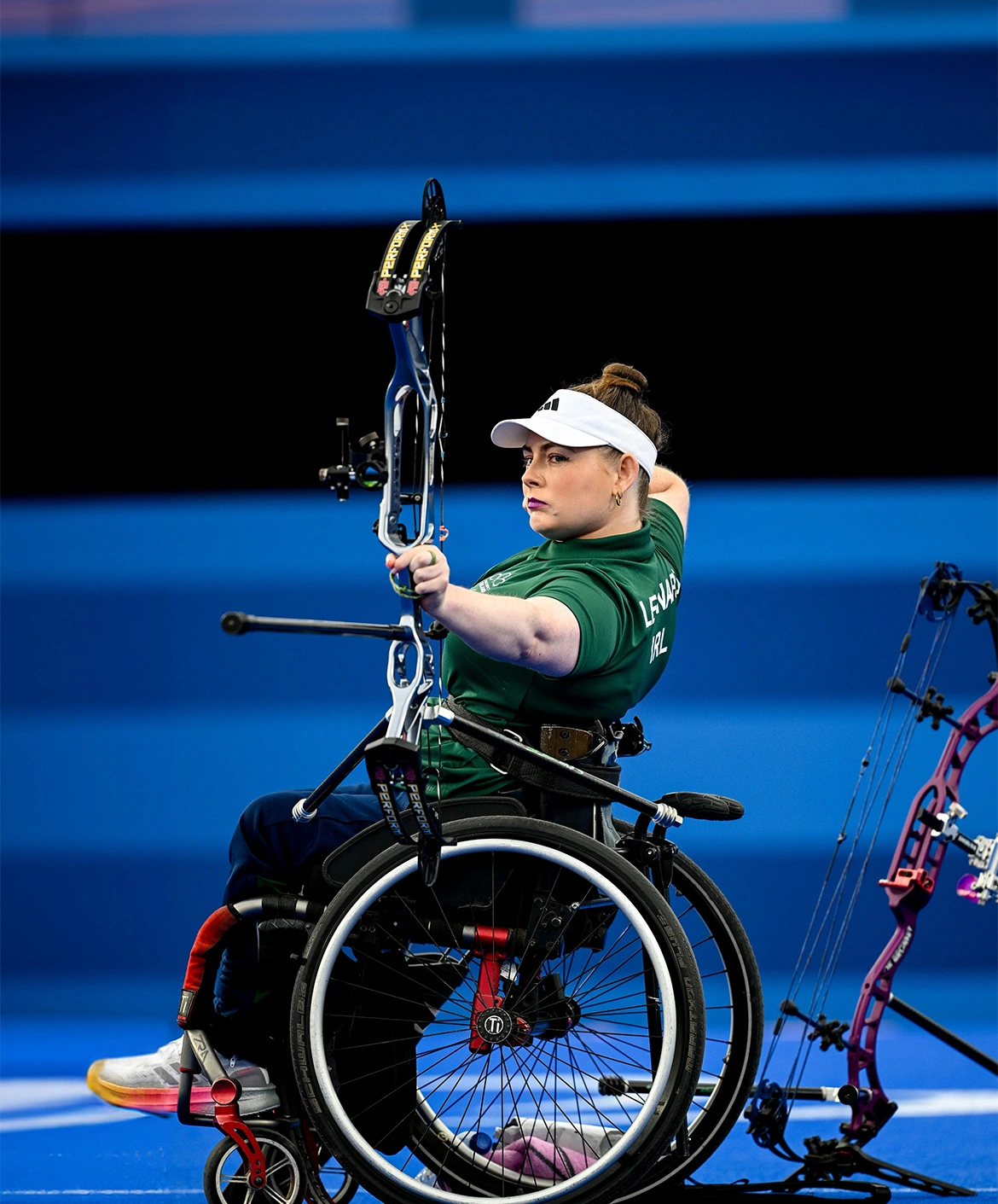
A female archer in a wheelchair, wearing a green Ireland team shirt and a white visor, draws her bowstring while aiming at a target. Another bow rests on the ground beside her. The background features a blue sports arena setting.
Paralympian Kerrie Leonard competing at the 2024 Paris Paralympics

The eldest of three siblings Kerrie was paralysed from the waist down after a fall from a tractor on her family farm when she was just six years old.  She recalls that in the years following the accident whilst her siblings were off playing various sports most evenings there wasn’t a lot of choice for her, especially living in a rural area. “I grew up in the countryside, where there was no visibility of disability sports at the time.  I didn’t go to community clubs. It didn’t really bother me because I had other interests but sport would be a big thing.  I am someone who likes to try things, I tried sand sailing, water skiing, basketball all that kind of stuff, not wheelchair, I would figure out a way to adapt it to myself.”

“I did take up archery because I was introduced to someone who was in a wheelchair, so I tried it.  I did a beginner’s course and tricked around with it a little bit and then gave it up like I did with most things.  I just kind of had a passing interest in it.”

Fast forward a few years and Kerrie is in college and in another twist of fate she is asked as a favour to join the archery club.  Someone who coached para archery Jim Conroy then asked her if she wanted to go to a para international competition. “It was an invitational before the London Olympics, and when we were governed by the IWA actually, and so it was all fully funded to for me to go, I didn’t really have an excuse , it was something for me to try. “So when I went to that competition and I saw firstly the number of people with disabilities, that was a bit jarring but then I saw I could actually compete quite well in this bunch of people so that encouraged me to take it up as an interest”

Kerrie finished 9th at the World Championships in 2015 and came second at the 2016 European qualifier when she came very close to qualifying for the Rio Paralympic Games.  With no European Championships possible for Tokyo (due to Covid) it was amalgamated into a Paralympic Qualifier. At this competition she finished 5th in the World Qualifier and 6th in the European Qualifier which earned her a bipartite slot for Tokyo where she finished 9th overall.

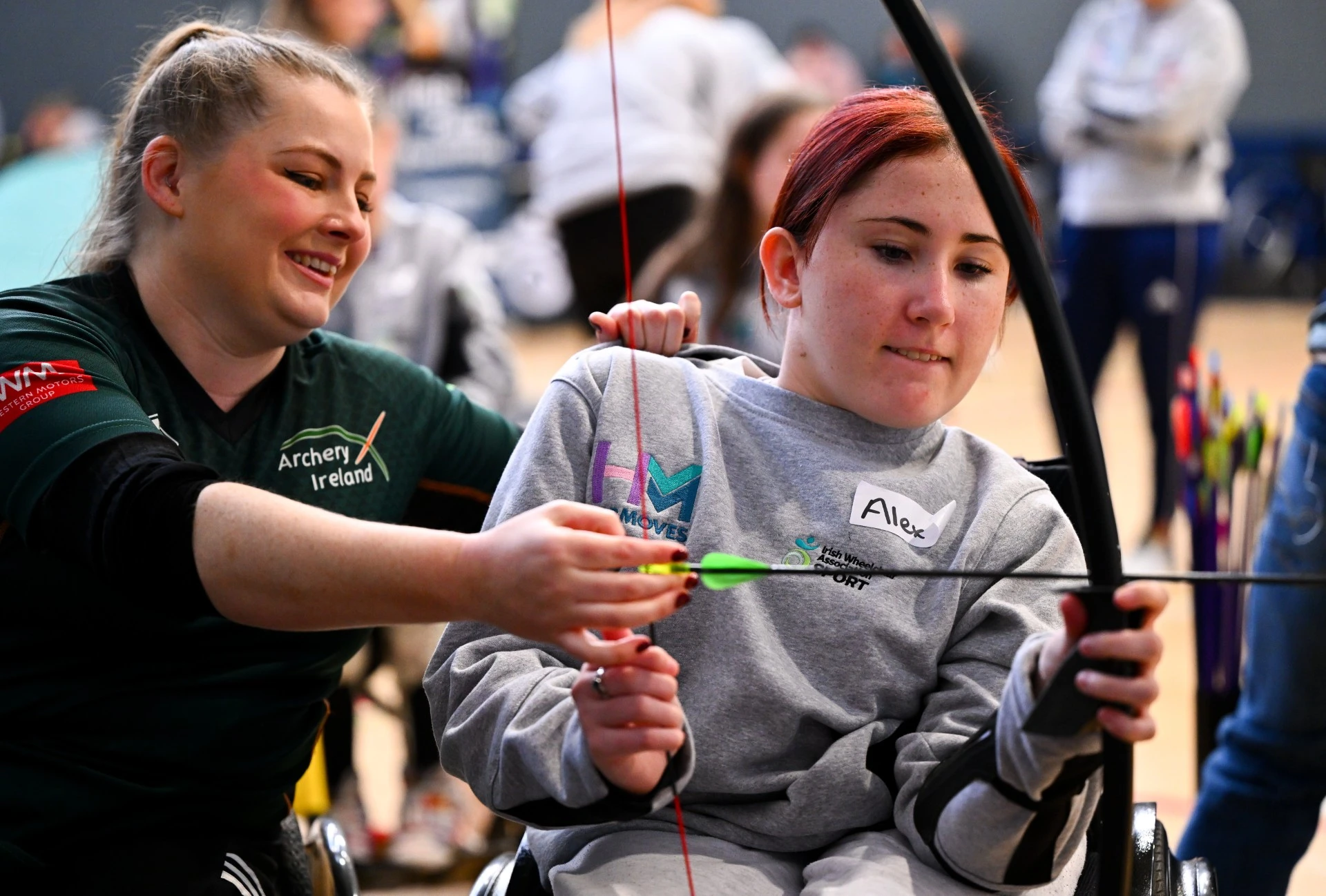
Kerrie Leonard, wearing a black 'Archery Ireland' jersey, is assisting a young woman named Alex in a wheelchair at an archery event. Kerrie is smiling as she helps Alex position an arrow on the bowstring. The background shows other participants and coaches at IWA-Sport’s Women in
Kerry Leonard teaches Alex at the HerMoves event for young women with disabilities at Irish Wheelchair Association

For Kerrie though the sport is much more about the competition. As someone who lives with depression, she attributes her involvement with para archery for helping her to get through tough times. She said: “I only really started being consistent going to archery because I was in a bad space, and I was worried that I was going to harm myself. So I went to a group of people who would notice if I wasn’t there.”

“We still don’t talk about this at all which is horrific, but everybody has been affected by a family member or a loved one who died by suicide. I certainly was too. I then had my accident and then a number of years later when I am in my teens and I’m trying to process all my emotions I had to make a decision then because everyone had grieved that death and then also everyone had grieved my accident. I personally at a very young age, didn’t feel it was okay to harm myself and force my family to grieve again. So I made a decision in my teens that could not be an option.  When I recognised those patterns potentially happening, then I had to make a game plan for it.”

Has Kerrie got her sights on the next Paralympics?

“I would love to be in LA, surrounded by the team again. But it’s something that I need to figure out because this year is very different, I’m older and I need to think about the future. I would have worked full time for an American tech company in sales and marketing and they don’t give you time off to train, so I worked alongside training for both games.  I left my role just before Paris.  I am not working now and currently job hunting. It is not viable to just do archery full time, maybe our para archers can put a business case to the Minister for Sport  but for the moment I would have to do both!”

Five with Kerrie
We find out even more about Kerrie Leonard!

Describe yourselves in three words: Self-deprecating, curious and I care.

Biggest fear: Needles

If you were Taoiseach for one day what would you do: I’d make everyone retake their driving test and I’d build a train line to Navan today and I would finish the Luas and the MetroLink to the airport.  I might actually prioritise getting a train to Donegal as well!  I’d also go in and I’d buy a load of concrete, and I’d raise the train platforms to make them accessible, but I’d have to supervise so the costs don’t spiral.  If the order comes from the office of An Taoiseach I feel that there would be couple of zeros added to the bottom line so I’d have to supervise!

Best piece of advice you’ve ever been given: The most useful piece of advice I’ve been given is that there is five miles in eight kilometres! I’ve used that piece of advice multiple times!

Who would you choose if you could be friends with a fictional character and why?  The only acceptable answer for the fictional character to be friends with is and will always be Samwise Gamgee from the Lord of the Rings because he is your friend in the trenches, he will show up for you even when you tell him to go home.

Page 2

Advocacy

Access; It's no joke. Share your top accessibility concerns in our quick poll—every voice counts
We know that access issues continues to be a major barrier for our members. Inaccessible pathways, lack of public transport options and lack of ramps are just some of the issues we hear about frequently.

Share Your Opinion

We are working on a campaign to highlight these issues to the public under the heading Access: It’s no joke, and we need you. If you would like to be involved in our next Access Campaign please send us your videos on issues that you simply hate.

You can email them to us at news@iwa.ie or WhatsApp at 087 773 7371. Please send us your name and location for inclusion by Friday, 21st March 2025

Please fill out our poll below to let us know your key issues.

Access Campaign Poll

Are you an IWA member?(Required)
Which of these issues affects you the most on a daily basis(Required)
Page 3

Fundraising

Take our Survey now and tell us about your taxi experiences
We often hear stories from Irish Wheelchair Association members that wheelchair users find it increasingly difficult to get an accessible taxi to pick them up - or that they run into issues when the taxi does turn up.

It is a huge issue throughout the country with reports of people frequently being let down when they ring to book an accessible taxi, leading to feelings of anger and frustration.

Have you experienced this?

FREENOW has teamed up with Irish Wheelchair Association and not only are they helping raise vital funds for our work through their ‘Round Up to Donate’ feature, but they are also committed to improving their service. As part of this, we want to hear about your experiences using taxis in towns, cities and communities across Ireland. Together, we are carrying out a survey so we can better understand the whys, the why nots and the how comes of using wheelchair accessible taxis and other taxi apps like FREENOW.

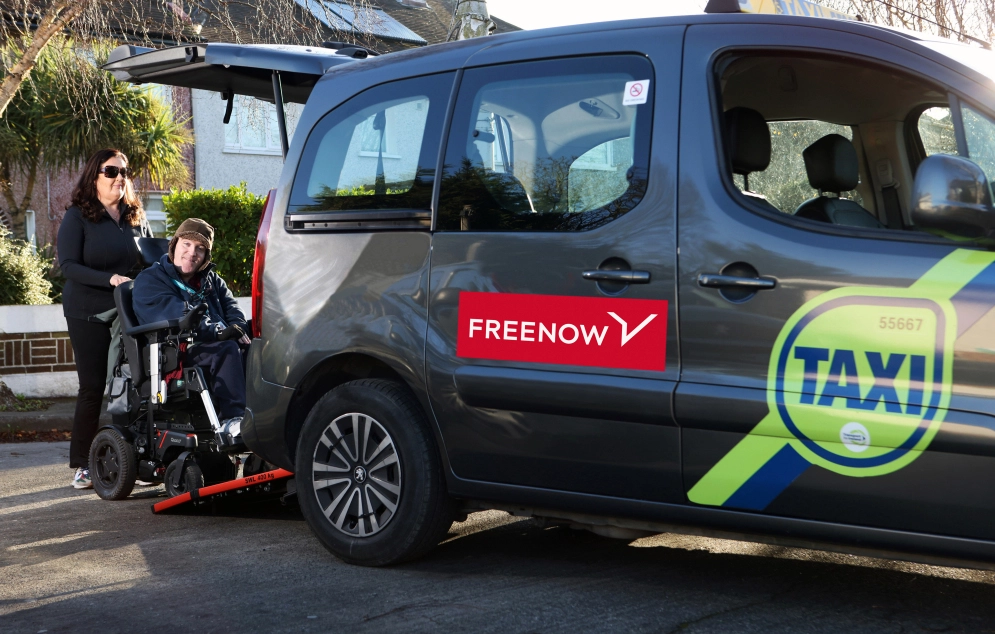
A wheelchair-accessible taxi with a 'FREE NOW' logo and a 'TAXI' sign is parked on a suburban street with its rear door open. A woman in a black jacket and sunglasses is assisting a person in a powered wheelchair onto the vehicle’s ramp. The person in the wheelchair is wearing a beanie and a navy jacket, looking ahead with a neutral expression. The background features a residential area with houses, trees, and a clear sky.
Free Now Taxi driver Rhonda Richardson and her IWA passenger Shane O’Farrell

We would love to hear from you. Your voice matters so please fill out the confidential survey

Earlier this month, FREENOW and IWA hosted a focus group in a centre in Cork to hear what our members had to say. Our members provided FREENOW with insights from those with lived experience of using this service. They are also supporting our advocacy efforts to expand the availability of wheelchair-accessible vehicles (WAVs) and improve taxi services overall for people with disabilities across the country.

Please complete the Taxi Experience survey today.

Page 6

Sport

International Women's Day - celebrating our female athletes
Spring is in the air, and we start the brighter season by celebrating International Women’s Day at IWA-Sport.

We spoke with female Para Athletes to share their experience in their respective sports. So meet Jade Flynn-Hurley, Ella Sherlock, Gabi van Rooyen and Casey Fitzgerald, all who thrive in their sport and have competed nationally and internationally.

Jade Flynn-Hurley – Wheelchair Rugby

I feel honoured of being 1 of 4 women that are able to say I have the opportunity to wear the Ireland jersey playing Wheelchair Rugby. A sport despite being male dominant, is very inclusive for woman to play on the same team.

I’ve travelled to many countries playing the sport, meeting inspiring athletes and making friends. A highlight for me would be competing in the Women’s Cup in Paris, where in 2024, Ireland sent its first ever female-only team to compete in the tournament.

To all girls, don’t be afraid. It can look daunting at international level. But it takes time, patience and hard work at training to compete at that level.

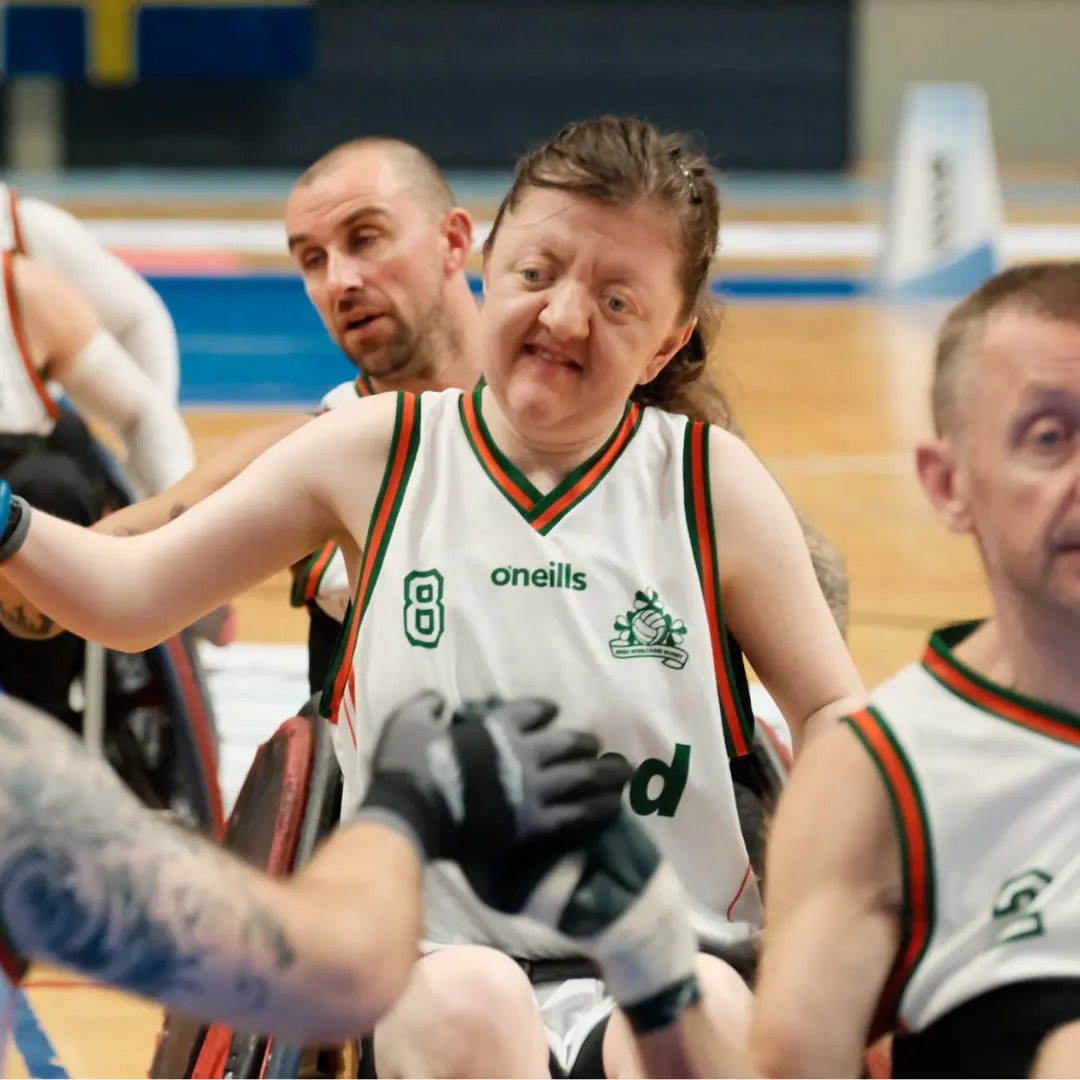
A woman in a wheelchair basketball uniform with the number 8, wearing a white and green jersey with orange trim. She is engaging with her teammates on the court, giving a handshake or high five, with other players in the background.
IWASport Member Jade Flynn-Hurley – Wheelchair Rugby

Ella Sherlock – Para Athletics

Para Athletics is an amazing opportunity to meet fellow competitors with similar challenges.  I have made new friends along the way and had the opportunity to compete abroad. I have competed in the United Kingdom, Portugal and the Czech Republic. Hopefully, over the next few years I will compete in even more countries!

There are many competitions the length and breadth of Ireland, I would strongly encourage anyone to come and give it a try!

A female athlete with light skin, wearing a yellow and green sports top with a race number attached, standing on an indoor track. She has a focused expression, her hair tied back with a green scrunchie, and her hands on her hips.
IWASport Member Ella Sherlock – Para Athletics

Casey Fitzgerald – Para Powerlifting

My experience of Para Powerlifting is the best thing that ever happened to me. The Irish team are so supportive and welcoming.

I have gained confidence and feel I found my calling in life. The competitions fill me with a buzz and it helps me set myself new challenges at each one, which I love! Para Powerlifting is empowering, good for your mental and physical health and extremely rewarding and enjoyable.

So what are you waiting for? Come join us and see for yourself!

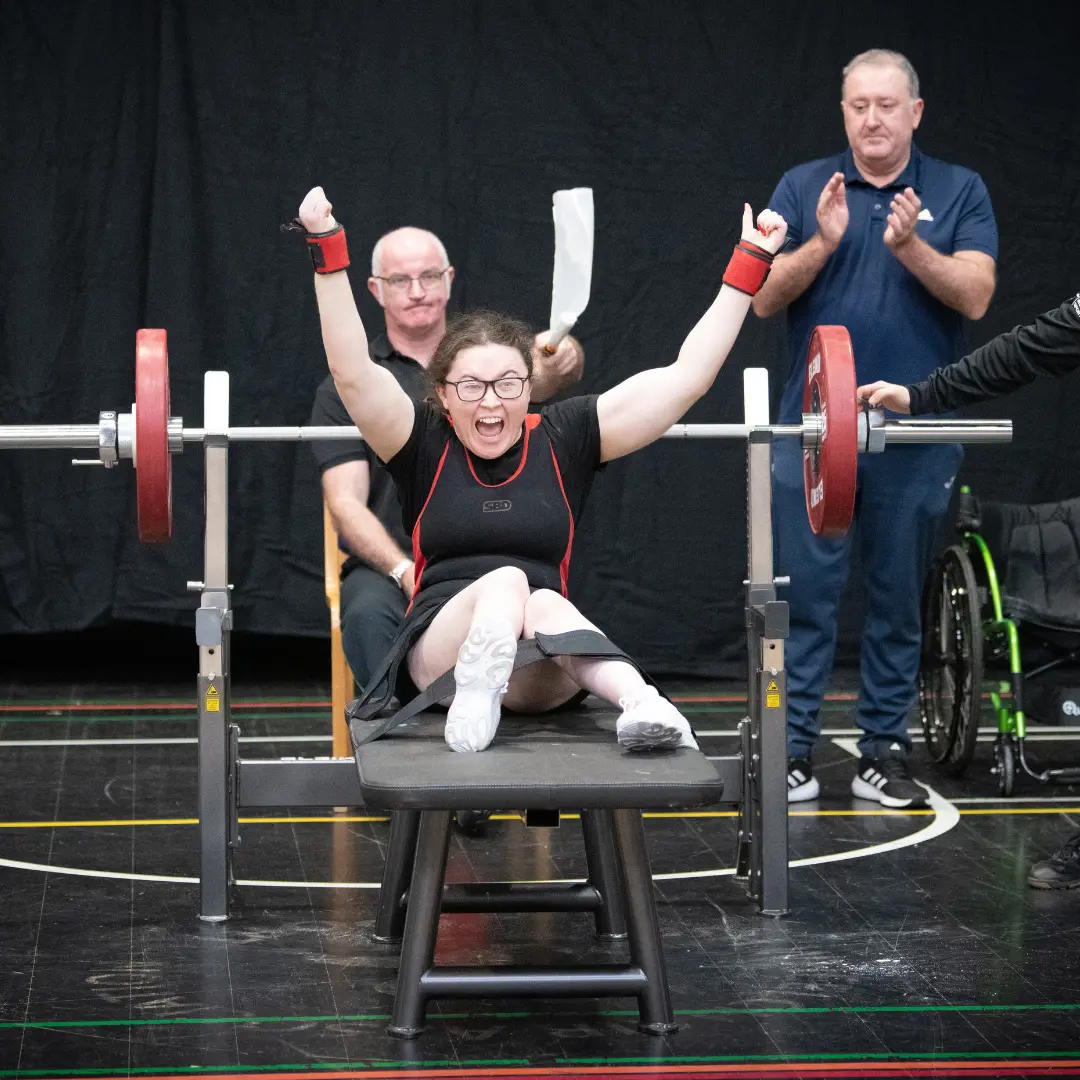
Person celebrating a successful lift at a weightlifting competition, with spectators clapping in the background.
IWASport Member Casey Fitzgerald – Para Powerlifting

Gabi van Rooyen – Wheelchair Basketball

I think my experience of being a woman in Wheelchair Basketball has been positive. Playing for both Killester and now Ballybrack Bulls, I have never felt like they are treating me differently cause of being a woman. I feel like I am being treated equally to my male teammates, and this can feel empowering at times as they don’t see me differently when we’re on the court together during training or matches.

For any women who want to come and try Wheelchair Basketball, I would say to give it a go, you might just find a new sport that you love. And trust me, you will make loads of friends who from my experience are now lifelong friends.

I know that it can be hard getting into sport as a woman as there’s not a lot of role models for us to look up to, or we might not be given the same opportunities as males in the same sport but it’s worth a shot if it’s something you enjoy.

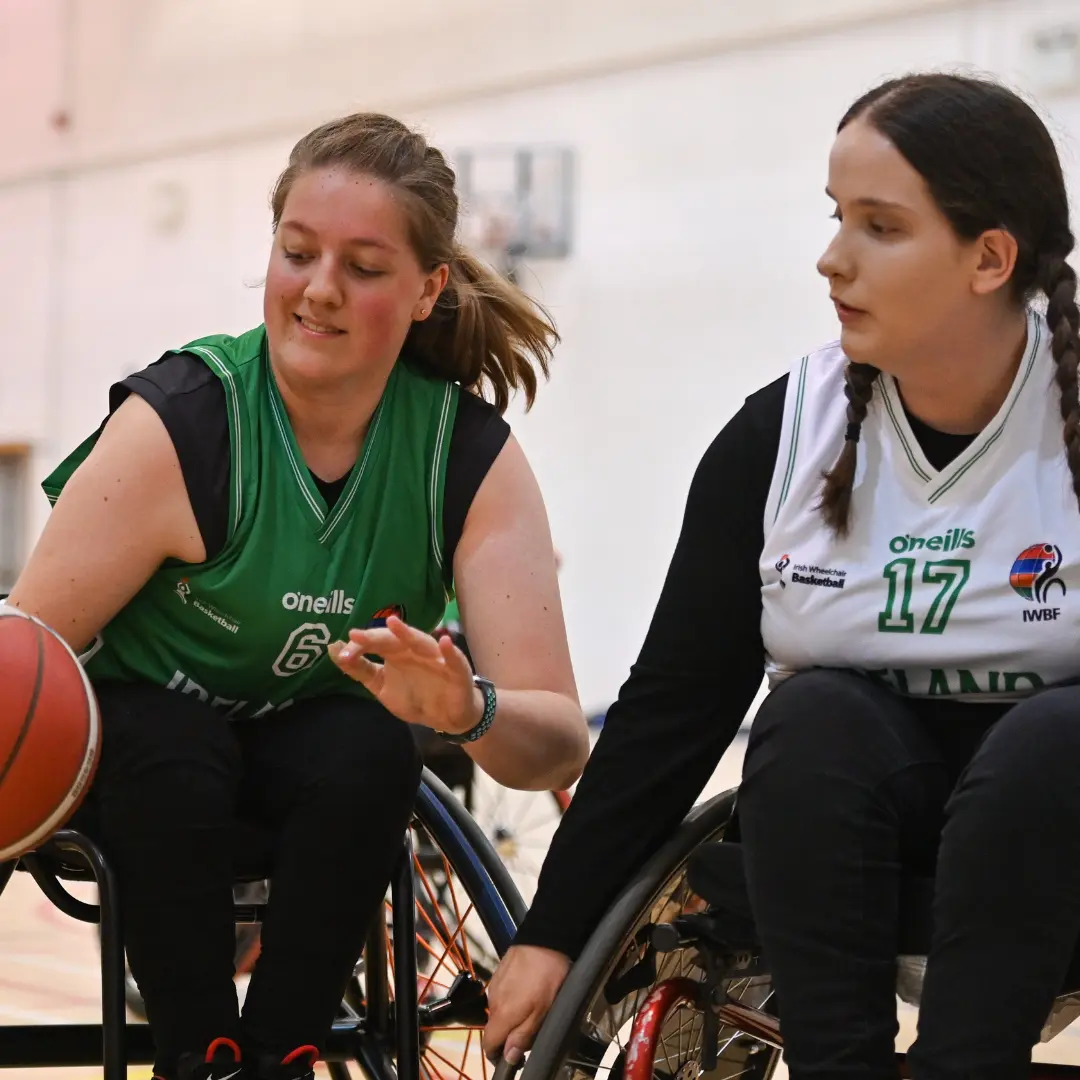
Two wheelchair basketball players from Team Ireland, wearing numbered green jerseys, are in action on the court, one of them holding a basketball.
IWASport Member Gabi van Rooyen – Wheelchair Basketball
Page 7

Volunteers

Keeping it in the family!
People become volunteers with IWA for all sorts of reasons. For Margaret Guiry from outside Carrick on Suir it was a case of keeping it in the family as when her daughter became a member she decided to join too – as a volunteer!

Her daughter Nicola, who has Cerebral Palsy and will be 30 this year, first became involved in IWA when she was 18 and began playing boccia. Outings and holidays soon followed.

Margaret remembers: “Before IWA Nicola had never gone on respite, we always had her at home.  So when she started going on the odd outing I went with her.  I enjoyed it, I met other parents, it was a little outlet for me as well.” But not every parent of IWA members become volunteers!  “I got hooked in and I have been a volunteer with the Tipperary IWA branch ever since. I am currently secretary of the branch for my sins,” she laughed. “We are like one big happy family.  Nicola has made loads of friends through IWA and I have too.”

The Tipperary branch organise outings and holidays and hold various fundraising events throughout the year to help pay for the activities. “We always get good support, people are generous.  Covid put a strain on fundraising but thankfully that’s over now.”

From Nicola’s point of view she says it is nice having her mother so actively involved as a volunteer with the branch. “She knows me and knows what help I need,” said Nicola, adding that the best part of being an IWA member is “meeting my friends and having fun”.

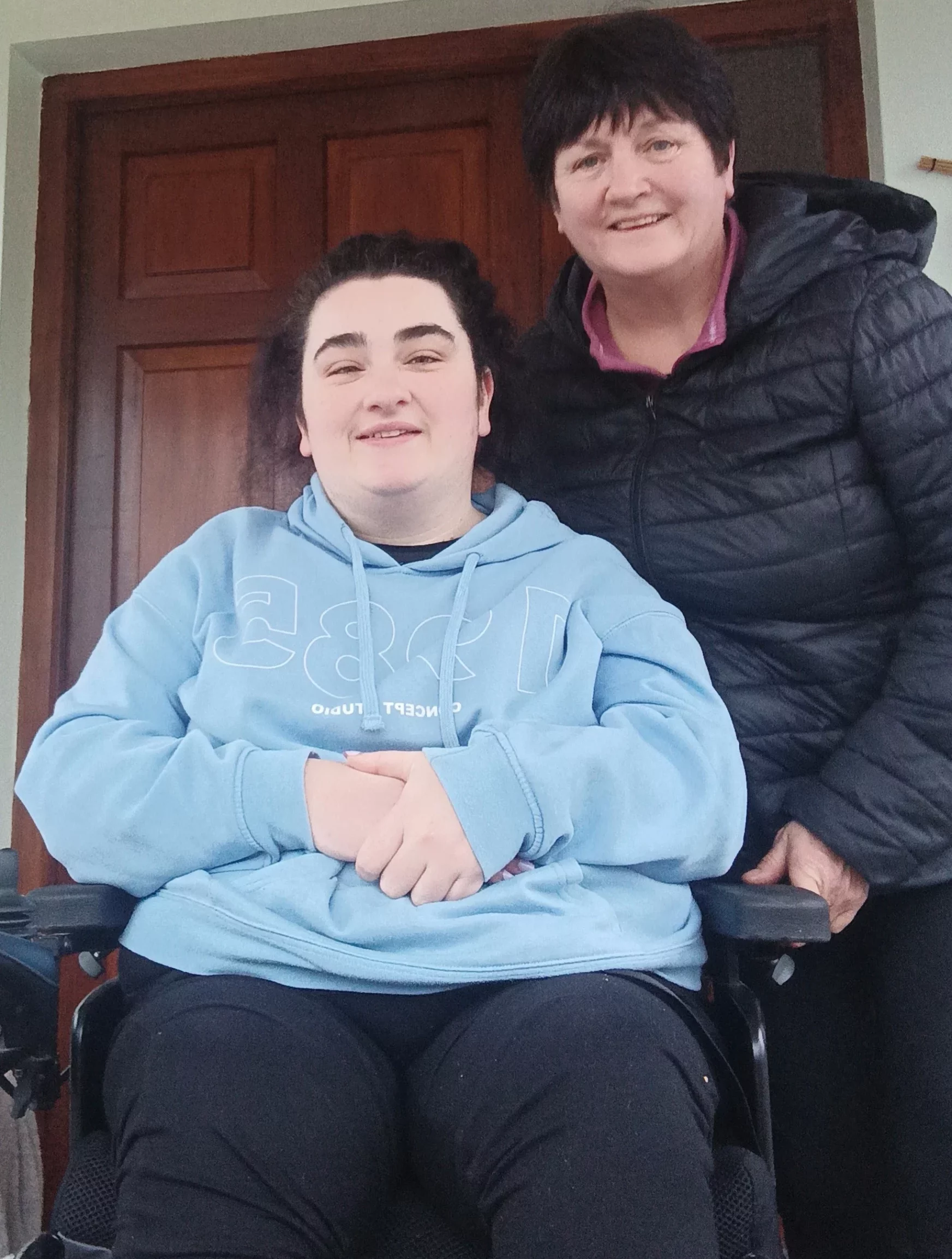
Margaret Guiry and her daughter Nicola, both members of the Tipperary Branch of the Irish Wheelchair Association (IWA), pose together outside a house. Nicola, sitting in a wheelchair, is wearing a light blue hoodie and smiles warmly at the camera, while Margaret, standing beside her in a black jacket, leans slightly toward her daughter with a happy expression.
Margaret Guiry and her daughter Nicola, both from the Tipperary Branch of IWA

Like her daughter Margaret really enjoys it too.  “It’s my life and I see how it benefits Nicola and her friends.  She really has made load of friends and but for the branch many wouldn’t get to do all the things that they do.  They enjoy being together, having the chat and living the life they are supposed to.”

“It is lovely visiting places as a group.  I find volunteering very rewarding.  You really do get a lot back.”

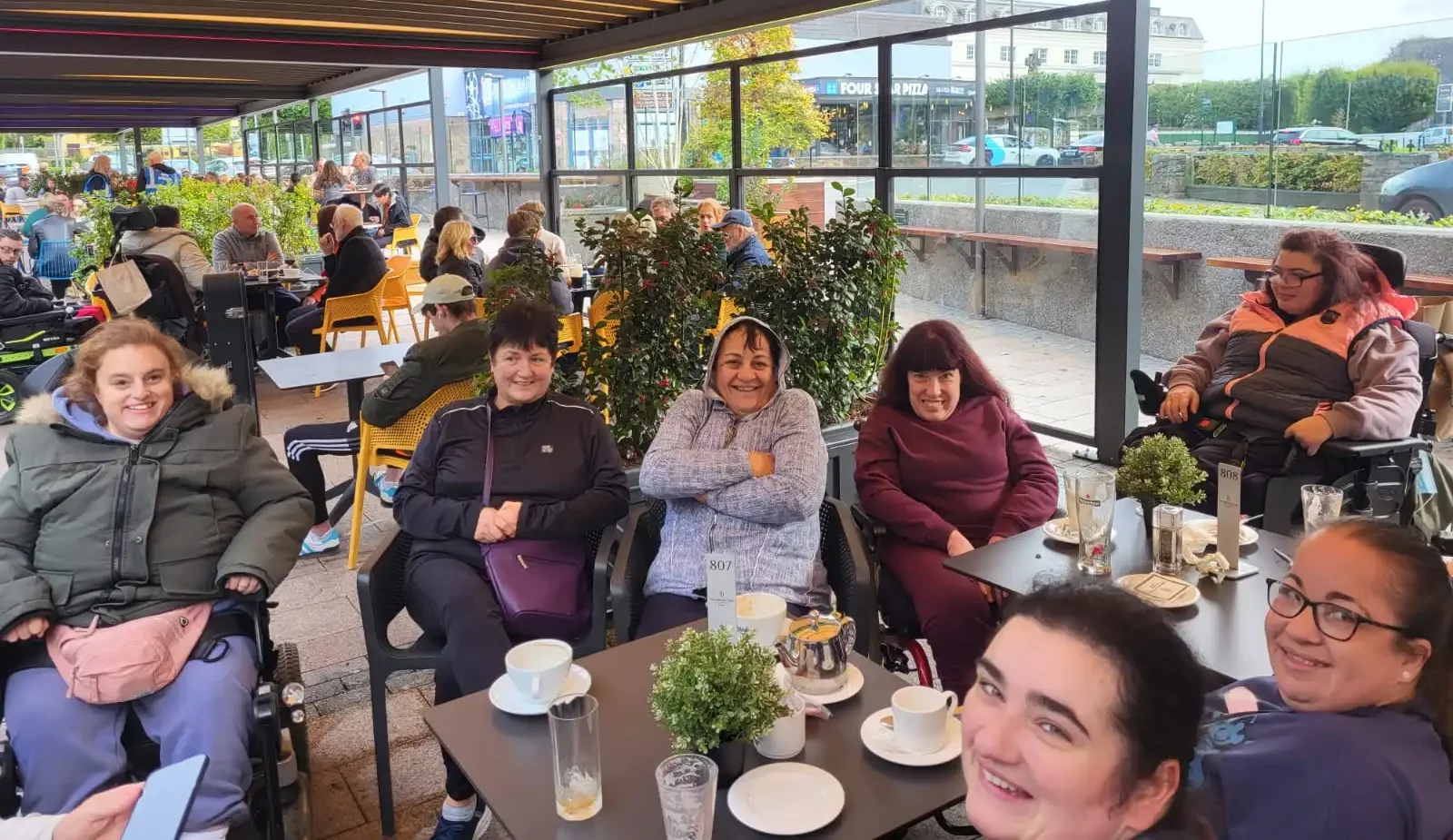
A group of members and volunteers from the Tipperary Branch of the Irish Wheelchair Association (IWA) are gathered at an outdoor café in Killarney, enjoying their annual holiday. The group, consisting of individuals with and without wheelchairs, is smiling and engaged in conversation over tea and coffee. The setting is a covered patio with yellow chairs, surrounded by other patrons in a lively and relaxed atmosphere.
Members and volunteers of the Tipperary Branch of IWA enjoying themselves on their annual holiday to Killarney.
Page 8

A New Chapter for Aaron Quinlan

Limericks with Impact: Carlow Creative Writers Group inspiring new authors
Creative Writing has brought a whole new dimension to Aaron Quinlan’s life. Born with Cerebral Palsy, Aaron has been a member of IWA since he was a child but only started going to the centre in Carlow about ten years ago, after finishing school.

He says: “This was the first real time I was mixing with other people with disabilities, apart from attending summer camps when I was younger.” He got involved in the Creative Writing Group last September and has been inspired to write his own Limericks about issues he feels are important.

The Creative Writing Group in Carlow began in 2014, thanks to funding from the Kilkenny/Carlow ETB. Facilitator Lissa Oliver, an award-winning novelist, was provided by the ETB, and enjoyed the group so much that she’s still there, 11 years later!

In that first year, original members Liz Mulvany, Louise Geraghty and Catherine McDermott, who remain members to this day, together with Freya Hope, Margaret Murphy and the late Emily J Byrne, put together an anthology of their work, called ‘In-House Writers’ Assembly” (IWA!!) which was published in 2014, raising funds for the Carlow Irish Wheelchair Association.

Lissa said more members joined and the group followed up with two further publications, “Write Away” and “The Return of Write Away”

Most recently in 2023, the group as it currently exists today, published their fourth collection, “The Return of Write Away 4” featuring Grace Doyle, Louise Geraghty, James Lennon, Catherine McDermott, Liz Mulvany, James O’ Dwyer, Ann-Marie O’Gorman, Marion Sheehy and Maria Walsh.
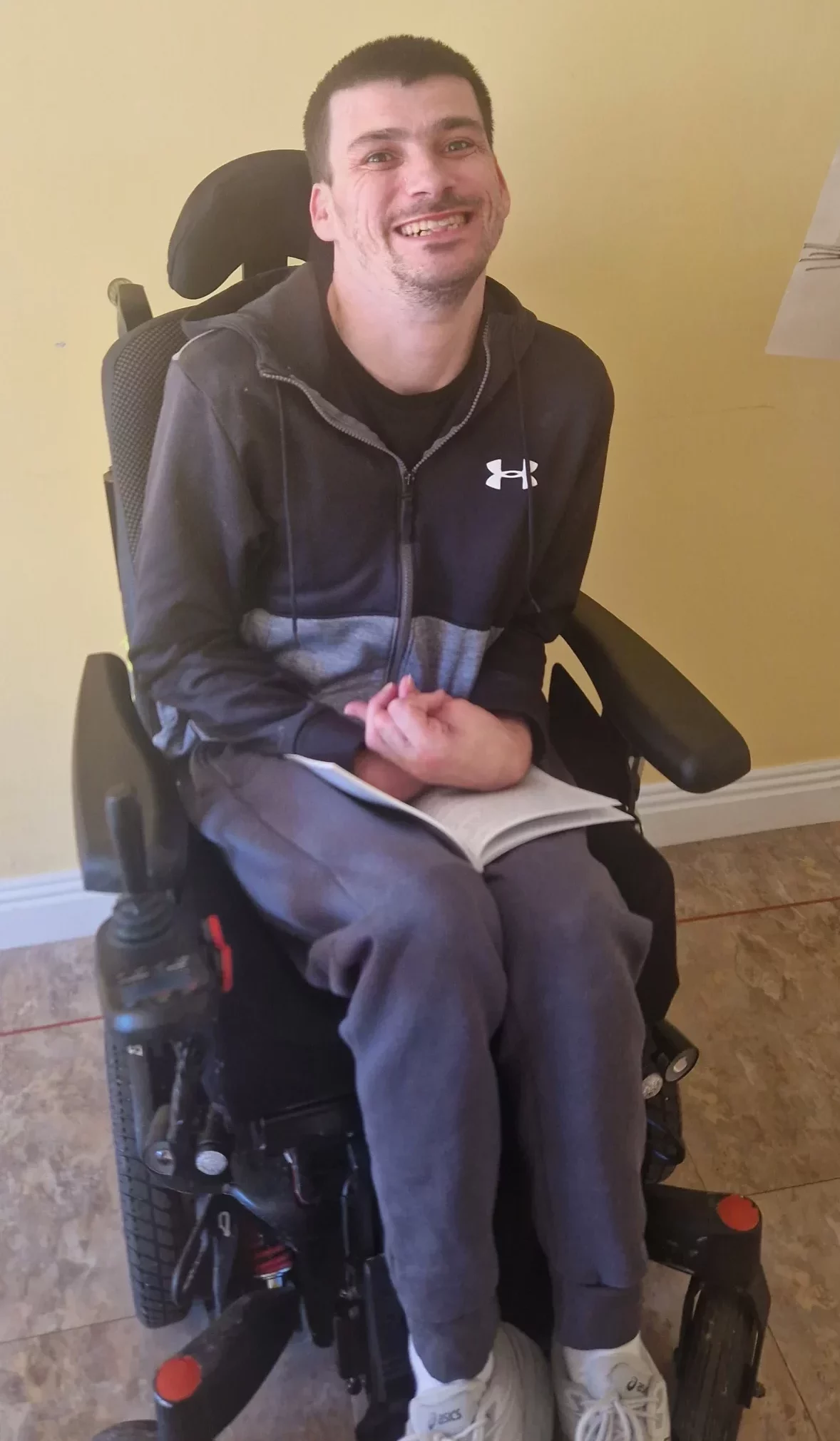
A young man with short dark hair and light skin is seated in a powered wheelchair, smiling brightly at the camera. He is wearing a black and gray Under Armour hoodie and matching sweatpants. A notebook rests on his lap, and his hands are gently clasped together. The background features a light yellow wall and a tiled floor.
IWA member Aaron Quinlan

“In between these publications, which were entirely self-published, the group doing the layout, editing, design and proof-reading themselves, adding new skills to their repertoire, not to mention fundraising and launch, James Lennon and Maria Walsh successfully published books of their own,” she praised.

At the time of the launch, Aaron rejoined the group, having been a member right at the beginning but the regular Wednesday night sessions clashed with his other activities.Now, Lissa points out, Aaron is another of the group’s prolific authors, specialising in Limericks, a form of poetry, usually reserved for humour but Aaron has brought his own voice to this medium and regularly writes about serious and important topics that affect us all, such as ease of access, prejudice and mental health.

He says: “I like getting topics from the tutor to think about and the challenge of how I can make a Limerick out of them or searching online for inspiration. It has made me become more aware of my surroundings when I’m out and about because I’m always looking for new things to write about. I enjoy the Creative writing group because I like hearing other people’s stories and talking about different ideas. I really like writing Limericks because of the unique structure, they’re short, to the point and can be funny or powerful.”

We are delighted to feature three of Aaron’s Limericks which we hope you will enjoy.

Writing can be very good for the mind

It can teach us to let go and unwind

So many possibilities

It lets people see past our disabilities

We can write about subjects of every kind.

By Aaron Quinlan

Black, white, straight or gay,

Just be nice so everyone can have a nice day.

Treat everyone the same,

Don’t be lame,

And trouble will not come your way.

By Aaron Quinlan

The beats of a heart can be strong,

You always hope nothing goes wrong.

Some people make it go fast,

It also won’t let you escape from your past.

When it stops, you’re finally gone.

By Aaron Quinlan
Page 5

Mobility Life

A look at non-motorised wheelchair attachments
Wheelchair technology has come a long way, and attachments now offer a whole new range of customisation. In this issue, we're focusing on non-motorised accessories — perfect if you don't want the hassle of batteries, motors and dreaded charging.

Whether it’s tackling tougher terrain or simply adding stability, non-motorised attachments are generally simpler to maintain and can be more budget-friendly than their powered counterparts. From front-end hand-cycle conversions to specialised push-rims, these products are designed to complement your current wheelchair. Below, we’ll look at four main categories explain how they work.

Breakdown of non-motorised attachments

  1. Hand-cycle (front-end) attachments
  2. Free-wheel & all-terrain front attachments
  3. Anti-tip & stabiliser bars
  4. Push-rim & grip modifications

1. Hand-cycle (front-end) attachments

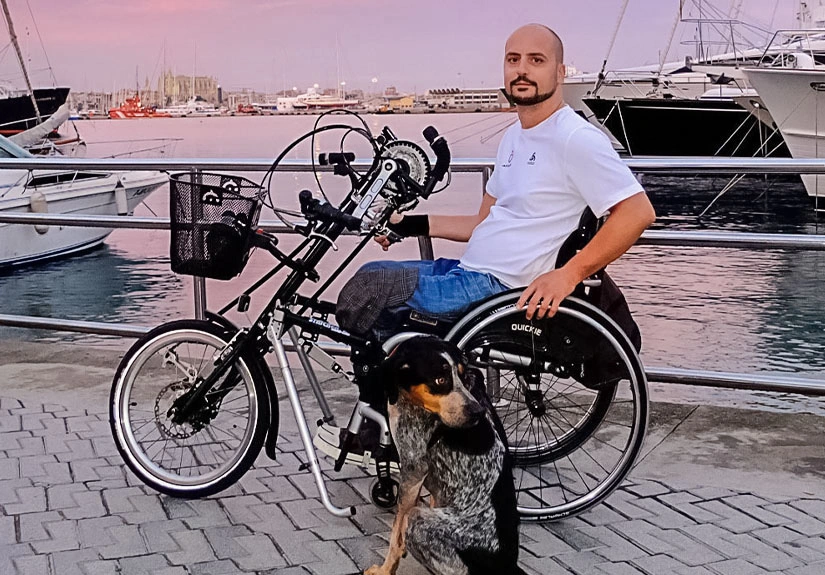
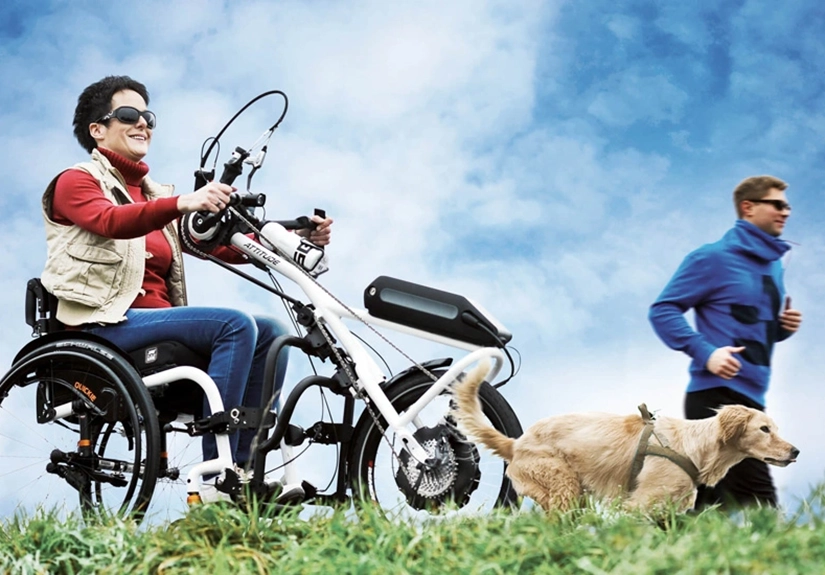
What they are: Handcycle attachments take over from you wheelchair’s front casters with a hand-pedalled wheel, effectively transforming your chair into a small hand-driven cycle.

image of a woman in a wheelchair wearing sunglasses smiling using a quickie attitude hand-cycle add-on alongside a man jogging who is also smiling and a pet dog

Quickie Attitude Hand Bike
image of man in a wheelchair using stricker wheelchair hand-cycle add-on in a pier with boars and yachts in the background. a dog is sitting bedside the man

Stricker CityMax Hand Bike

How they benefit you:

  • Ideal for staying active and building upper-body strength.
  • Offers speed and freedom on smooth roads or paths.
  • Easily detached so you can revert to using your wheelchair as normal.

Models you might see:

  • Quickie Attitude Manual – A clamp-on system with a lightweight build.
  • Stricker Handbikes (Manual Series) – Known for adjustable gearing and user-friendly mounting.

Possible Issues:

  • Can be very large and awkward to transport in vehicles.
  • Hand-bike attachments while excellent for fitness, do require reasonable upper body strength.

2. Free-wheel & all-terrain front attachments

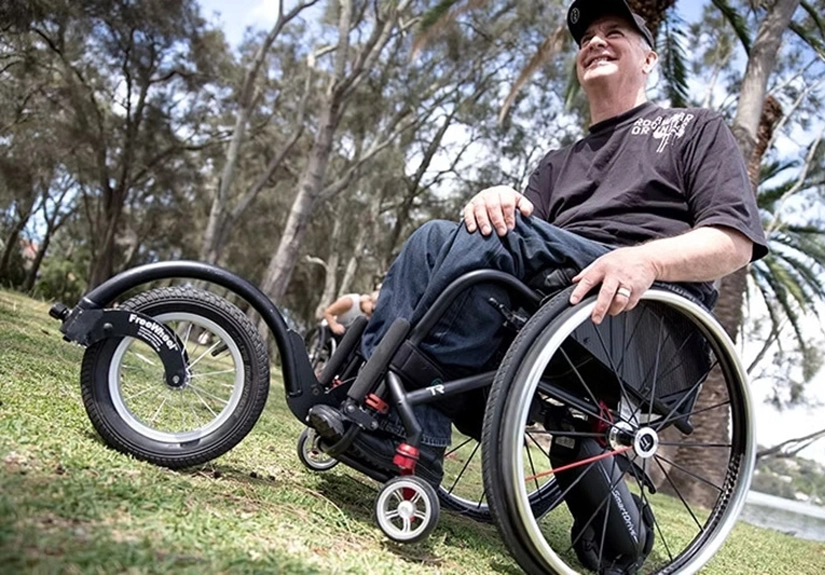
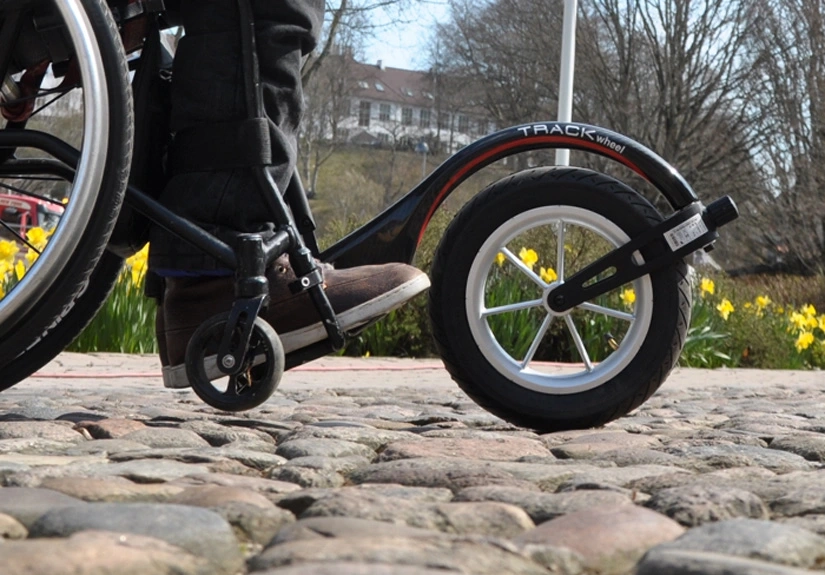
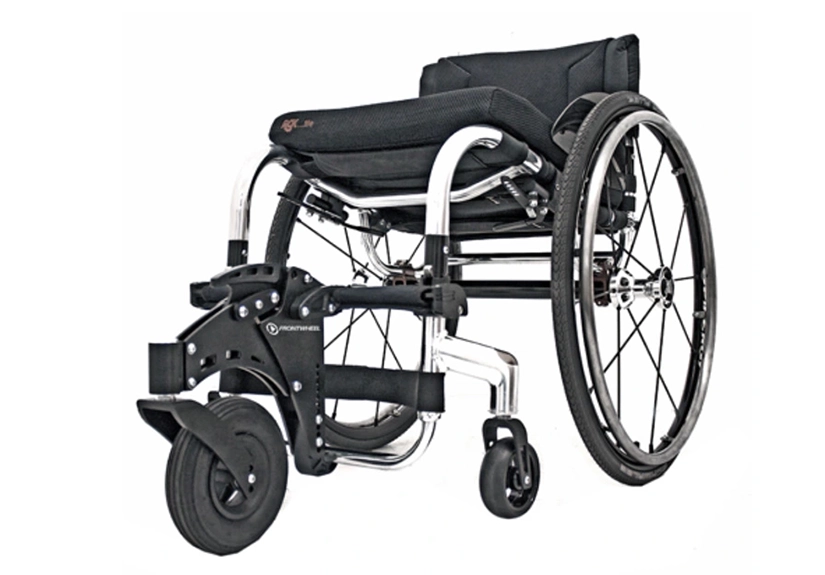
What they are: A single, large front wheel or specialised caster replacements that elevate your small casters off the ground, making it easier to roll over uneven surfaces. These usually clamp to your footplate or the front bars of your chair.

image showing a man in a wheelchair in a green area with a freewheel wheelchair attachment on the front

Freewheel
image showing closeup of a wheelchair with a trackwheel attachment on a cobbled path

Trackwheel
image showing an empty wheelchair with a front wheel attachment installed

RGK Front Wheel

How they benefit you:

  • Reduces the chance of front casters getting stuck on bumps, gravel, or grass.
  • Adds flexibility for rough or outdoor environments.
  • Usually easy to attach and remove but depends on the type of footplate or wheelchair you have.

Models you might see:

  • FreeWheel – A popular, widely recognised choice for off-road mobility.
  • RGK Front Wheel – An alternative on the FreeWHeel and attaches to the front bars of your chair which might offer more stability.
  • Track Wheel – A double-arm alternative that’s a mix between the FreeWheel and FrontWheel.

Possible issues:

  • The FreeWheel clamps to your footrest and works very well but can be tricky with non-standard footplates.
  • Sometimes takes a bit of tweaking to make sure the setup is stable and your front casters are raised off the ground enough.
  • May not fit onto all chairs well like manufacturers claims.

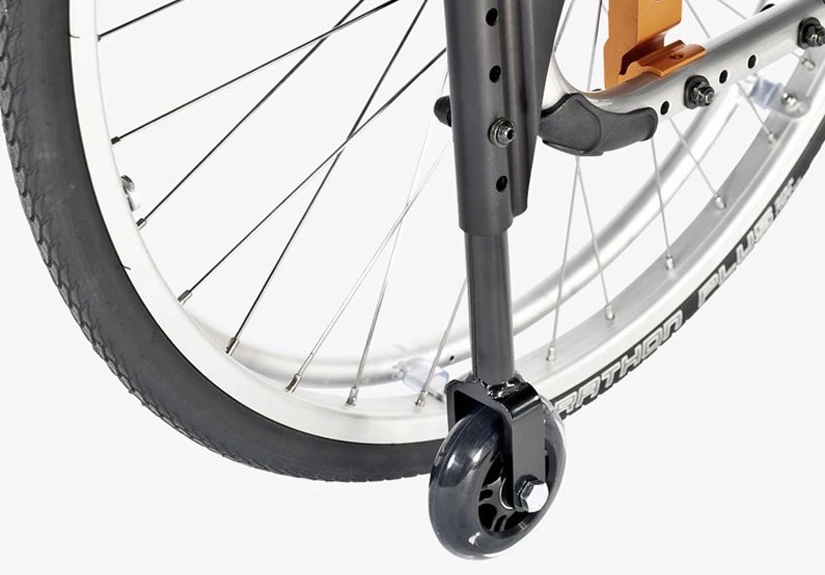
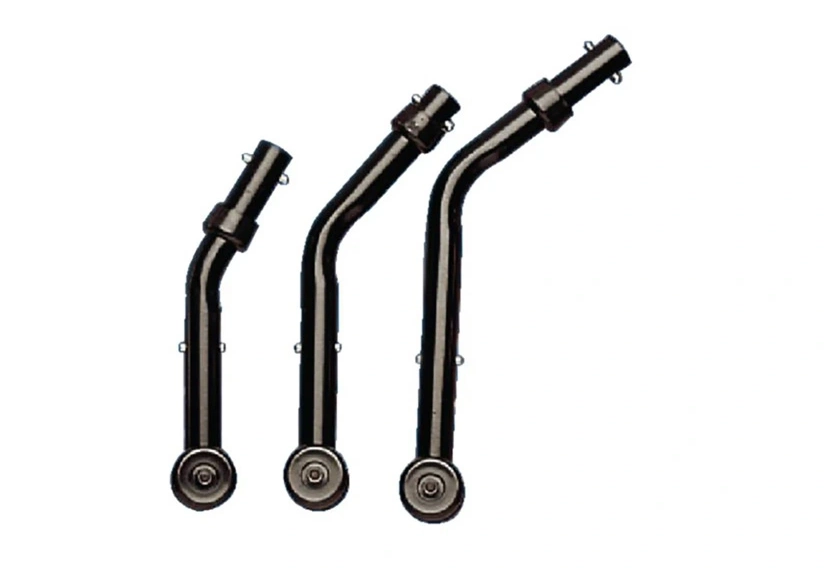
3. Anti-tip & stabiliser bars

What they are: Small bars or extensions attached to the back (or sometimes front) of the chair to reduce the risk of tipping.

image of a wheelchair with anti-tip vertical wheel

Quickie Anti Tip
image of a selection of wheelchair anti-tip attachments

Invacare Anti-tip

How they benefit you:

  • Offers added security on ramps or while transferring.
  • Helps you feel more confident over uneven ground.
  • Often adjustable to match your chair’s angle and height.

Models you might see:

  • Quickie anti-tip device – Compatible with many Quickie chairs and adaptable for others.
  • Invacare rear anti-tippers – Standard stabiliser arms with adjustable height settings.

Possible issues:

  • Can impeded chair operation if not fitted correctly.
  • may not provide a strong enough support as they are detachable.

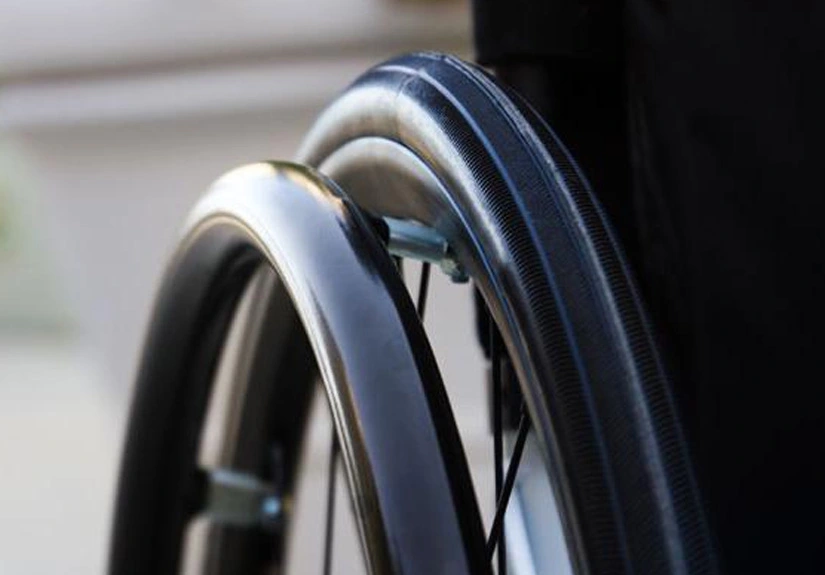
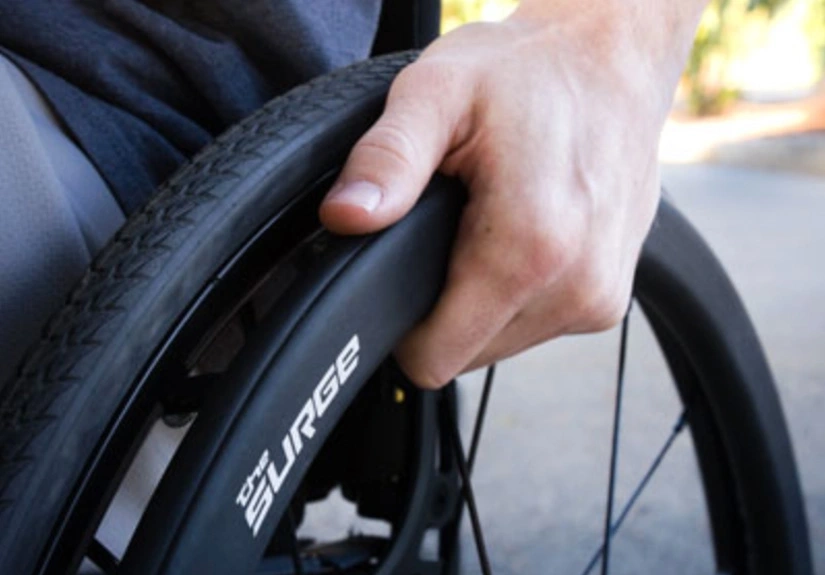
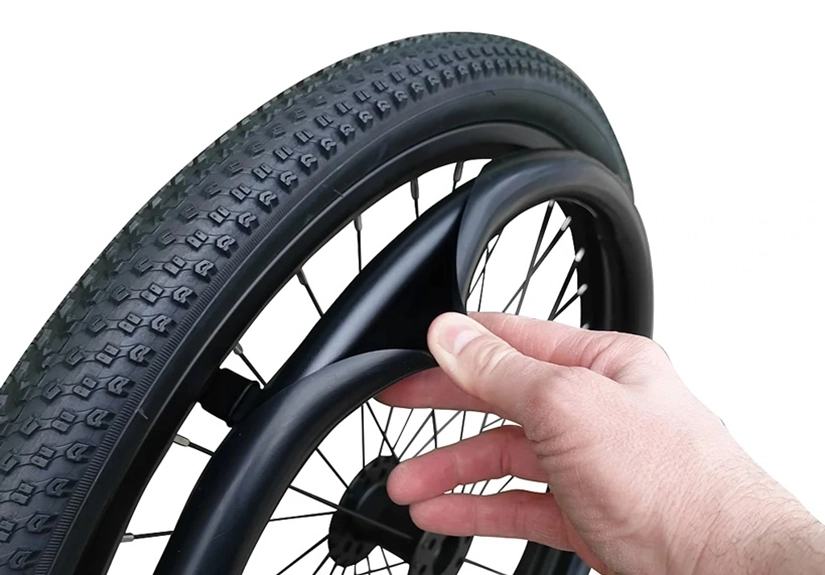
4. Push-rim & grip modifications

What they are: Enhanced push-rims or grip coatings that improve traction for your hands on the wheel rims.

image closeup of a wheelchair wheel rim

Q-Grip Coated Rims
image showing a closeup of a man's hand pushing a wheelchair rim

Surge LT Rims
image showing a closeup of a man's hand pushing a wheelchair rim

PushGrip Rim Covers

How they benefit you:

  • Makes pushing less strenuous, especially in wet conditions.
  • Can reduce hand and wrist fatigue with added grip or ergonomic shapes.
  • Typically a simpler, lower-cost upgrade.

Models you might see:

  • Surge push rims – Rubberised top-strip on an oval push-rim for stronger drive and better grip.
  • Q-Grip – Coated rims noted for lasting traction.
  • PushGrip – Ultra Grip rim covers.

Possible issues:

  • Can be harsh on your hands and may cause blistering if not used to pushing.
  • Can lose grip or effectiveness over time/wear and tear.
  • Surge rims are very popular but are particularly expensive.

Conclusion

When selecting a non-motorised attachment, consider how you use your chair and what you want to achieve. If you’re an avid explorer looking for a workout, a hand-cycle attachment might be just the ticket.

On the other hand, if you mainly need some extra help on uneven surfaces or want to minimise tipping risk, anti-tip bars or all-terrain wheels could be your best bet. Push-rim modifications are great if you’re after just a small bit of extra assistance.

Above all, it’s worth checking in with a professional like an occupational therapist to ensure compatibility with your specific wheelchair and to get advice tailored to your needs. With the right attachment, you’ll find it easier to travel, exercise, and go about your day in the way that suits you best.

Image credits:
Freewheel
Invacare
PushGrip
Stricket Handbikes
Sunrise Medical
Rehasense
RGK Wheelchairs

Page 4

Thanks for your company

If you like what you're reading, please spread the word!

Share Spokeout March 2025


Share this article on Facebook Share this article on Instagram Share this article on LinkedIn Share this article on X

Remember:
Your voice, your choice! We're all ears for your feedback, thoughts, and suggestions.
Share what topics intrigue you the most and what you'd love to see in future magazine features.

Share your feedback here

Spokeout Cover Image Logo
SpokeOut is Irish Wheelchair Association's lifestyle magazine published every month for our members.
© Irish Wheelchair Association 2025.