Print Issue: May 2025

This is a printer-friendly version of the Spokeout magazine.

⚠️ Important for Best Results:

  • Browser: Use Chrome, Edge, or Safari.
  • Settings: Ensure "Background Graphics" is CHECKED in the print options.
  • Margins: Set margins to "None" or "Default".
Spokeout Cover Image Logo
Spotlight on:
Jack O'Connor
The Power of Assistive Technology
Other Features:
Learning how to drive with IWA, Adaptive Fashion options plus lots more

Spokeout May 2025

Welcome to Summer. We're extremely excited to share this month's edition of Spoke Out with you.

We have packed this issue full of new and interesting articles, including our Mobility Life feature, which shares some great insights on assistive technology, and building on the popularity of our feature on Penney’s adaptive fashion, we have expanded this piece with lots of additional information on where to source fashionable adaptive clothing. Lorraine Regan shares her experience of learning to drive with IWA, having started a new job, and IWA-Sport athlete, Jack O’Connor, shares his passion for farming and Para Athletics with us.

Our fundraising team bring you a heartwarming story of community and friendship through the lens of member, Neil Farry who attends our Carrick-on-Shannon Community Centre. Neil was a postman and lived a busy life until one morning, he tripped on a footpath when he was out delivering post.

Advocacy continues to work on IWA’s Pre-Budget Submission, which will be presented at Dail Eireann in Dublin on Tuesday, May 27th, and we would love to see you there, if you can make it. We also share some of the topline results from the online Pre-Budget survey, huge thank you to everyone who responded.

This and so much more awaits you in this edition, so please grab a cuppa and take a couple of moments out of your day to read on.

We hope you enjoy,

Pam

Magazine Logo
Spotlight on:
Jack O'Connor
The Power of Assistive Technology
Other Features:
Learning how to drive with IWA, Adaptive Fashion options plus lots more

In this issue:

  • Spotlight on: Jack O’Connor
    Para Athletics has changed my Life
  • Advocacy
    Join our Pre-Budget Campaign
  • Fundraising
    Community is Friendship – Support our Community Centres Today
  • Learning how to drive with Irish Wheelchair Association
    "Why didn't I do this ten years ago?" - Lorraine Regan
  • Mobility Life
    The Benefits of Assistive Technology in the Home
  • Adaptive Fashion: Style Meets Function
    Empowering Self-Expression for Every Body
  • IWA launches first-ever Young Adults Skillsfest
    Competitions in Art, Boccia, and more
Page 1

Spotlight on Jack O’Connor

Para Athletics has changed my Life
Jack O’Connor is an IWA member who was born with cerebral palsy. His journey into Para Sport and Para Athletics began from just the age of five when he joined Father Murphy’s Athletic Club in Athboy, Co. Meath.

“From a young age, my family and I looked for ways to improve my coordination. I started Para Athletics when I was just five-years-old with Father Murphy’s Athletics Club because I struggled to throw a ball. “Para Athletics gave me the opportunity to build those skills in a fun and structured way. That’s also where I met my coach Paddy Hanley, who’s been with me since day one. His support and belief in me have played a massive role in my journey.” 

After nine years of taking part in Athletics (with Father Murphy’s Club), Jack was introduced to IWA-Sport and from there, began to take part in Para Athletics. “When I was 14, I started competing in Para Athletics. It was thanks to Sarah and Suzanne Ledwit getting in touch with the Irish Wheelchair Association that I got the chance to take part in competitions. Their support, along with my coach’s encouragement, helped push me to the next level—and I haven’t looked back since.” 

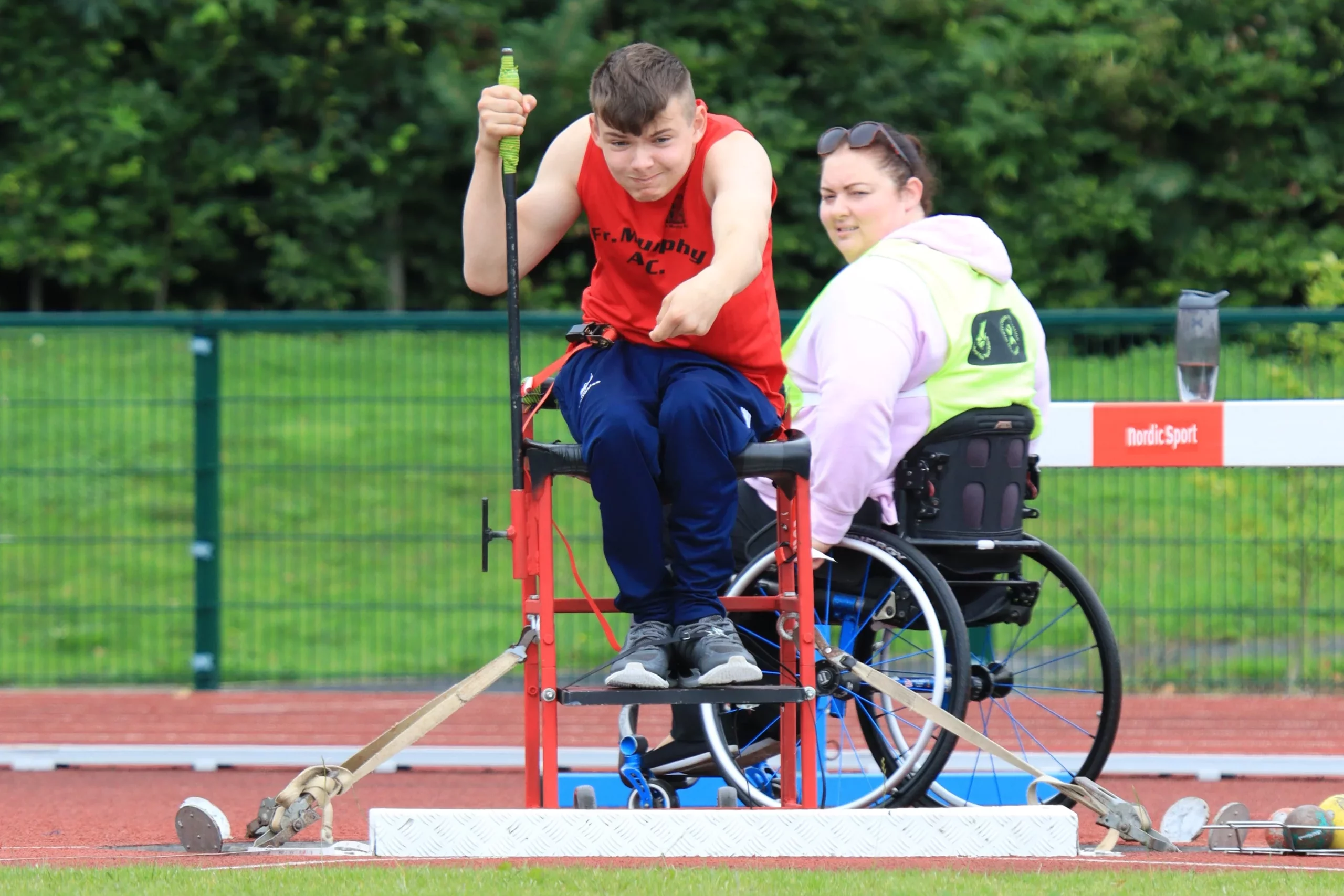
A young male athlete in a red tank top participates in a Para Athletics event, throwing a ball while sitting in a specially designed throwing chair. A woman in a wheelchair stands beside him, offering guidance.
Jack O'Connor, competes with the support of his coach, sharing his journey with Spoke Out.

“I now compete in discus, javelin, and shot put. I train four times a week, always looking to improve. I love the challenge of these events—the mix of strength, skill, and mental focus. There’s nothing quite like the satisfaction of landing a good throw after all the effort you’ve put in. “But I wasn’t always this good at athletics—it’s taken a lot of hard work, trial and error, and consistency to get here. There were plenty of times things didn’t go to plan, but I kept showing up, kept learning, and kept pushing forward. That’s what made the biggest difference.” 

Competing in Para Athletics has presented some special moments for Jack.  “One of my proudest achievements came in 2023 when I competed in the Czech Open and brought home a bronze medal. I’ve also travelled to Coventry twice, where I competed against athletes from Wales and Scotland – and came home with three gold medals. Moments like those remind me why I love this sport and keep me aiming higher.” 

Collecting medals and travelling is one thing but he also reflects on how competing in Para Athletics has benefited his day-to-day life. 

“Para Athletics has changed my life. It’s helped me grow in confidence, gain independence, and stay focused on my goals. It’s given me the tools to face challenges head-on and the mindset to keep pushing no matter what. More than that, it’s connected me with an incredible community of athletes and coaches who inspire and support each other.” 

When not training for Para Athletics, playing Wheelchair Basketball with North East Thunders Club or in school, Jack works on the family farm. He shares how he’s adapted to farm-life with a physical disability. “Outside of Para Athletics, I live a busy life on the farm. I’ve got my tractor licence and even built my own hand controls so I can drive it myself. I lift myself into the tractor and take on the work like anyone else – it’s physical, it’s tough, and I love it. Farming keeps me grounded and strong, both physically and mentally. “The skills I’ve developed through Para Sport – like resilience, problem-solving, and discipline help me every day, whether I’m training, competing, or working on the farm. They’ve shaped how I approach life and given me a sense of pride in everything I do.” 

The 2025 Para Athletics season began at the end of April with the Leinster Games in SETU Carlow. What are O’Connor ‘s goals over the coming months?

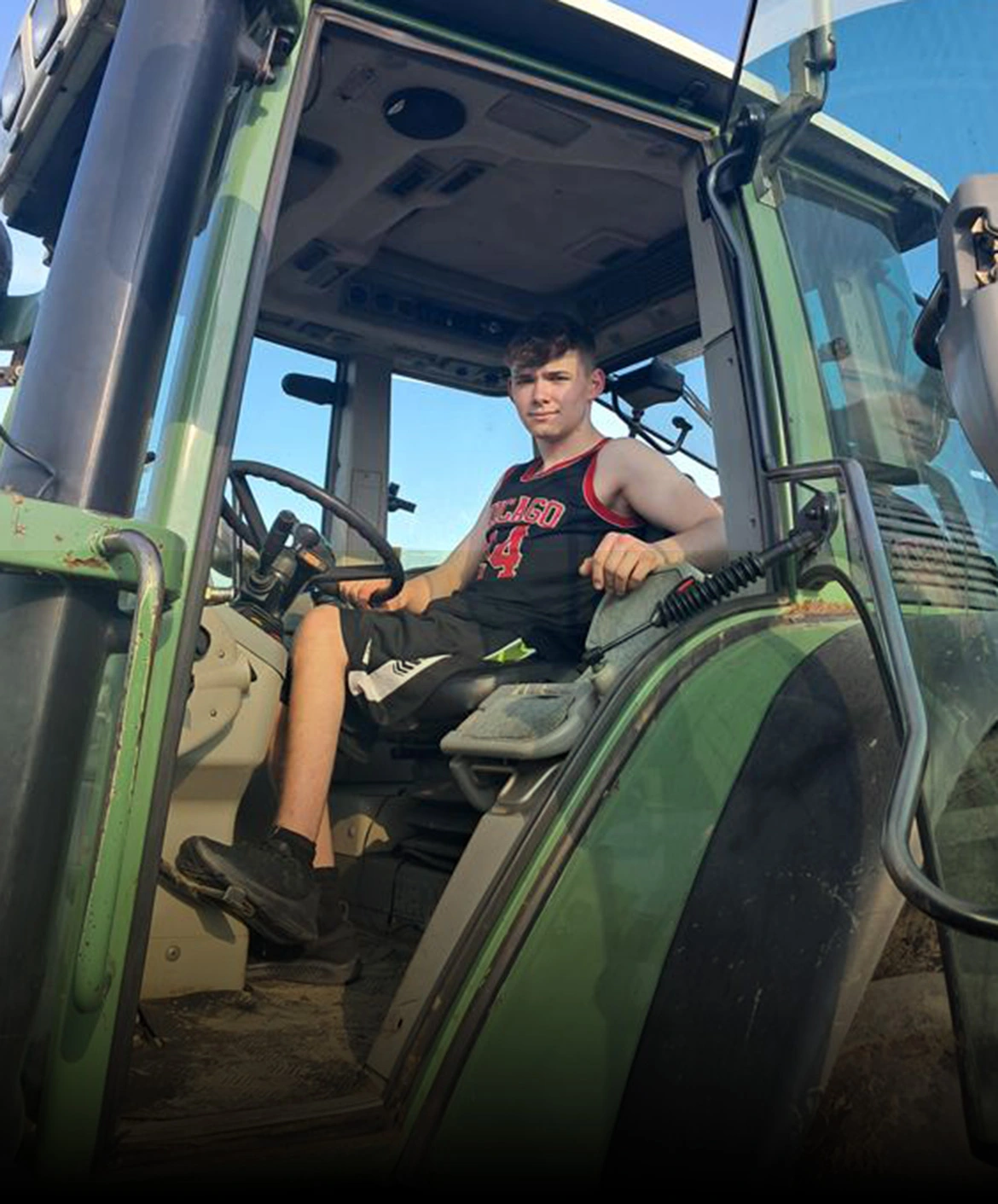
Jack O'Connor, a young male athlete, sits in the driver's seat of a green tractor, wearing a black tank top with "Chicago" written on it and shorts. The tractor’s interior is visible, with a clear blue sky in the background. Jack’s posture is relaxed as he poses for the photo.
Jack O'Connor balances his sporting career with life on the farm

 “This season, my goal is to hit new personal bests and qualify for more international events. But my bigger dream is to represent Ireland at the 2028 Paralympic Games in Los Angeles. That’s what I’m working toward with every training session – step by step, throw by throw.” 

He encourages others to get involved in Para Athletics. “To any parents with a child, or to any young person with a physical disability thinking about Para Athletics—I’d say go for it. Whether you’re starting to build coordination or chasing big dreams like the Paralympics, Para Sport has so much to offer. It will give you confidence, strength, and a sense of purpose. Taking that first step could change your life, just like it did mine. “And always remember, it doesn’t matter what your disability is, you can do anything in Para Athletics. There’s such a wide range of disciplines in Para Sport that there’s something for everyone. 

“You just have to give yourself the chance.” 


Page 2

Advocacy

Join our Pre-Budget Campaign
Thank you for taking the time to fill out our survey included in the last Spoke Out. The response has been fantastic, and it has given us some great insights to back our Pre-Budget submission. 

We asked you questions that ranged from Cost of Disability, Housing, Transport, Personal Assistants and Sports and below are some of the results: 

  • Cost of Disability – 92% incur an extra cost of disability 
  • Employment – 86% of people said they were unemployed 
  • Personal Assistants – 44% have been waiting for over 12 months for PA service 
  • Transport – 69% of people said there are extra costs on transport  
  • Transport – 77% of people said they rely on family and friends for transport 
  • Housing – 50% of people said they are not living where they would choose to live
@p
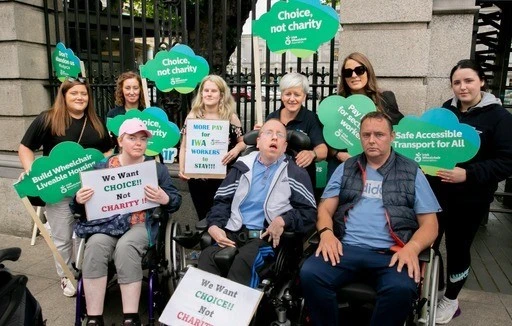
A group of people holding signs that read "We Want CHOICE! Not CHARITY," "Build Wheelchair Accessible Housing," and "Safe Accessible Transport for All." The group includes wheelchair users, caregivers, and supporters, all participating in a demonstration in front of a building.
Members of IWA show a united front outside the Dáil, advocating for greater accessibility and choice.

Please join us for the launch of the Pre-Budget Campaign on Tuesday May 27th at 11:00am outside Leinster House. 

We are looking for spokespeople so if you would like to get more involved, please contact me at joan.carthy@iwa.ie

We will also launch the digital part of our campaign in early June and will share more on that in next months’ edition.

Together, we can make a difference.


Page 7

Fundraising

Community is Friendship – Support our Community Centres Today
The chances are if you are a member of Irish Wheelchair Association you have been to one our bustling 65 Community Centres across the country.

The centres are the beating heartbeat of IWA, where a huge variety of activities and programmes take place but most of all they are where our members find friendships, fun, fulfillment as well as an abundance of support and the chance to explore new opportunities and challenges. Our members love being around their friends with whom they can have a laugh and enjoy time together.   

 As a person-centred organisation no one community centre is the same but what is consistent is the warm IWA family welcome each person receives. Neil Farry is one such person.  In his mid-fifties Neil has been attending our community centre in Carrick-on-Shannon for the past eight years now, usually attending on Tuesdays and Thursdays.  He says: “I find it brilliant here. It’s a fantastic outlet from (my) hospital situation to get in here.  It is huge release for a couple of hours.  Just meeting people of a similar frame of mind – a small bit of normality.” 

Neil was a postman and lived a busy life working around Carrick-on-Shannon. One morning he tripped on a footpath when he was out delivering post. He hit his head which resulted in a serious brain injury, leaving him with significant memory and cognitive issues. Neil’s life has never been the same since.  “I’m ten years in hospital”, he said. 

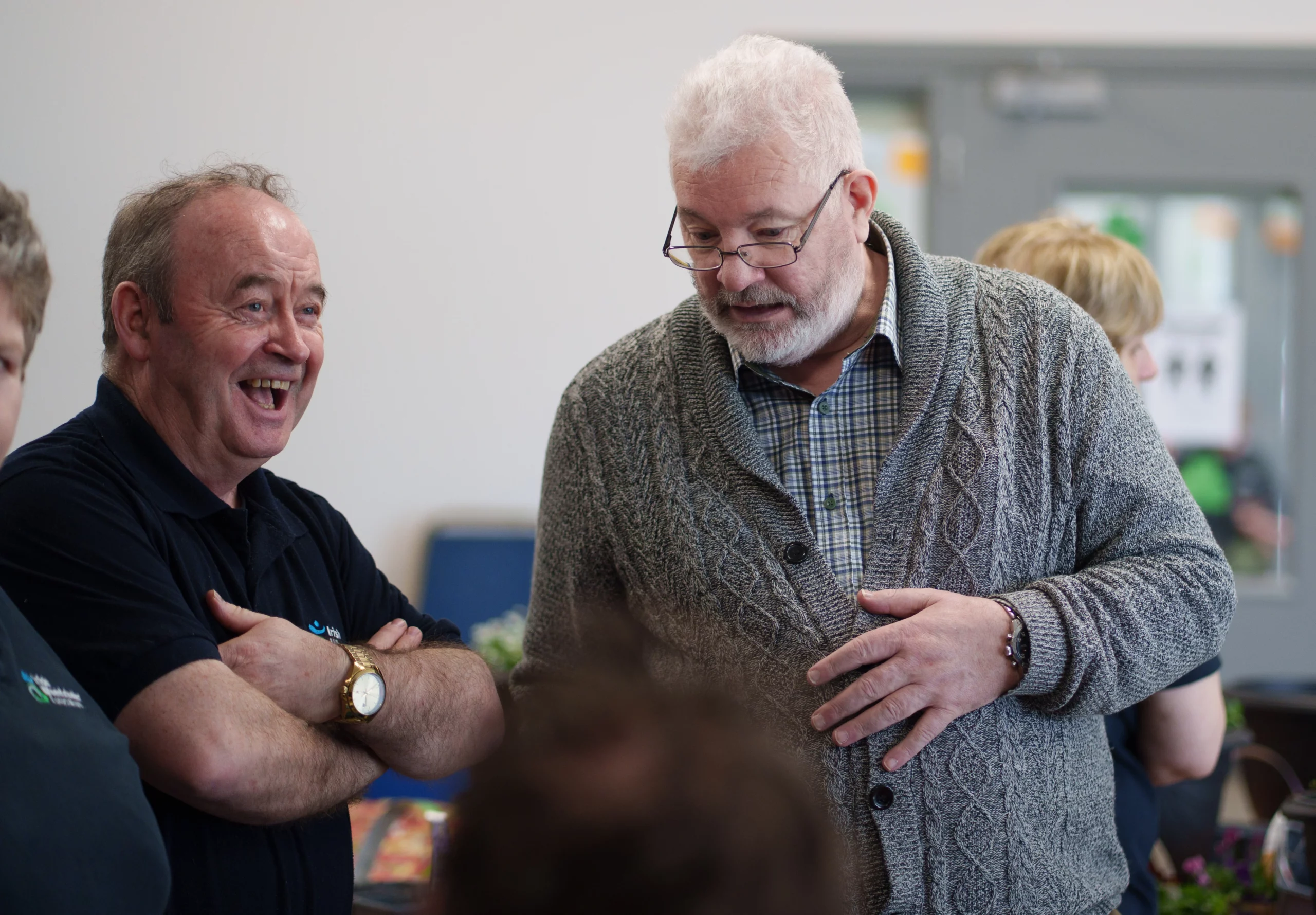
Two men smile and converse with each other, one wearing a gold watch and a dark shirt, while the other has gray hair and a knitted cardigan. Both are engaged in a friendly discussion in a relaxed setting.
Neil Farry (R) pictured with staff member Paddy Coleman

Neil was initially treated in Sligo hospital but because of his memory and cognitive issues he could no longer live in his home alone, like before. He now lives in a local hospital in Carrick-on-Shannon, which is for elderly patients with Alzheimers, which he is grateful for.  However, his goal is independent living 

“I am a spring chicken in the hospital. Even at my age of 55. Most people are in their 70’s and 80’s. It’s basically an Alzheimer’s unit, that’s where I am. While it is a fantastic facility, the staff don’t have time to sit and have a chat and the people who are there don’t know what’s going on a lot of the time.” 

So, Neil really looks forward to attending IWA’s Community Centre.  “It’s a huge release for a couple of hours, the complete relaxation of it all, the chat with staff and members, playing games, cards. The day trips are usually very good. They are very forward thinking in what goes on here. They aren’t too difficult or taxing. For us it’s just about getting on a bus. That’s what’s enjoyable.” 

“You can leave your troubles at the door. When you come in here, your needs are looked after. Some people have more needs than others and that’s looked at. That’s the one thing that I would always say everyone is individual here and everyone is treated that way.” 

Neil appreciates each week that he has an IWA staff member who goes with him into town to run errands independently and get some jobs done. 

What is the difference for Neil when he cannot get to the IWA centre? 

“I miss meeting people and the chats. It’s all about everybody, the whole group. Everyone is treated as a person.” 

Page 5

Learning how to drive with Irish Wheelchair Association

"Why didn't I do this ten years ago?" - Lorraine Regan
For Lorraine Regan (34) from Kilcormac, County Offaly, starting a job in a nearby community centre was the beginning of a busy two years. Lorraine has not only adapted to working life but has also learned how to drive.

Lorraine began working in a local community centre as an administrator in March 2023. “It’s a really really busy community centre with meals on wheels, remote working hubs, local sports clubs,” she says.  

Lorraine spent the first year of work relying on lifts from her family until she decided it was time to learn to drive for herself. Although her family were always on hand to drop or collect her, “it was more me wanting to do it”, says Lorraine.  

As a child Lorraine had been a member of IWA-Sport, throwing Javelin, but she wasn’t sure where to start when it came to driving lessons, “I rang IWA in Dublin, and they put me in touch with Barry Reid in IWA Athlone.”

Lorraine’s only regret is she didn’t start driving sooner. That is her advice to anyone nervous about learning to drive, “just do it. There’s nothing to be afraid of. I would say don’t do what I did and leave it for so long. Now that I’ve started I think – why didn’t I do this ten years ago?! It gives you the freedom to come and go whenever you like.”

Lorraine was very nervous at the start, but she persevered and began to find things easier, “Oh I was really nervous at the start. I’m normally so talkative, but I wasn’t even able to talk in my first couple of lessons because I was so nervous trying to concentrate” laughs Lorraine. But Barry will tell you that soon changed!”  

Barry Reid is a driving instructor and assessor at Irish Wheelchair Association, based in Athlone, Westmeath. Barry says that although Lorraine was clearly nervous at the beginning, her determination to keep trying and practicing paid off in the end. “Anyone who sits into a car for the first time to learn how to drive is nervous. Everyone is the same. But it’s amazing what a bit of time and patience can do.”  

Lorraine passed her test in March of this year, two years to the day that she began her job in the community centre. She has been enjoying her freedom ever since. “Today I finished work early and before I would have had to ring my parents to see is anyone around for a lift. But today I could just go home myself. I love driving.” 

Later in the week Lorraine is driving to Tullamore alone for the first time, which will be another milestone reached,  “I’m getting my nails done so I have to drive into town and park up myself. But I’m grand getting the wheelchair in and out of the car- but I suppose it’s just different when you’re in a busy place,” she said.  
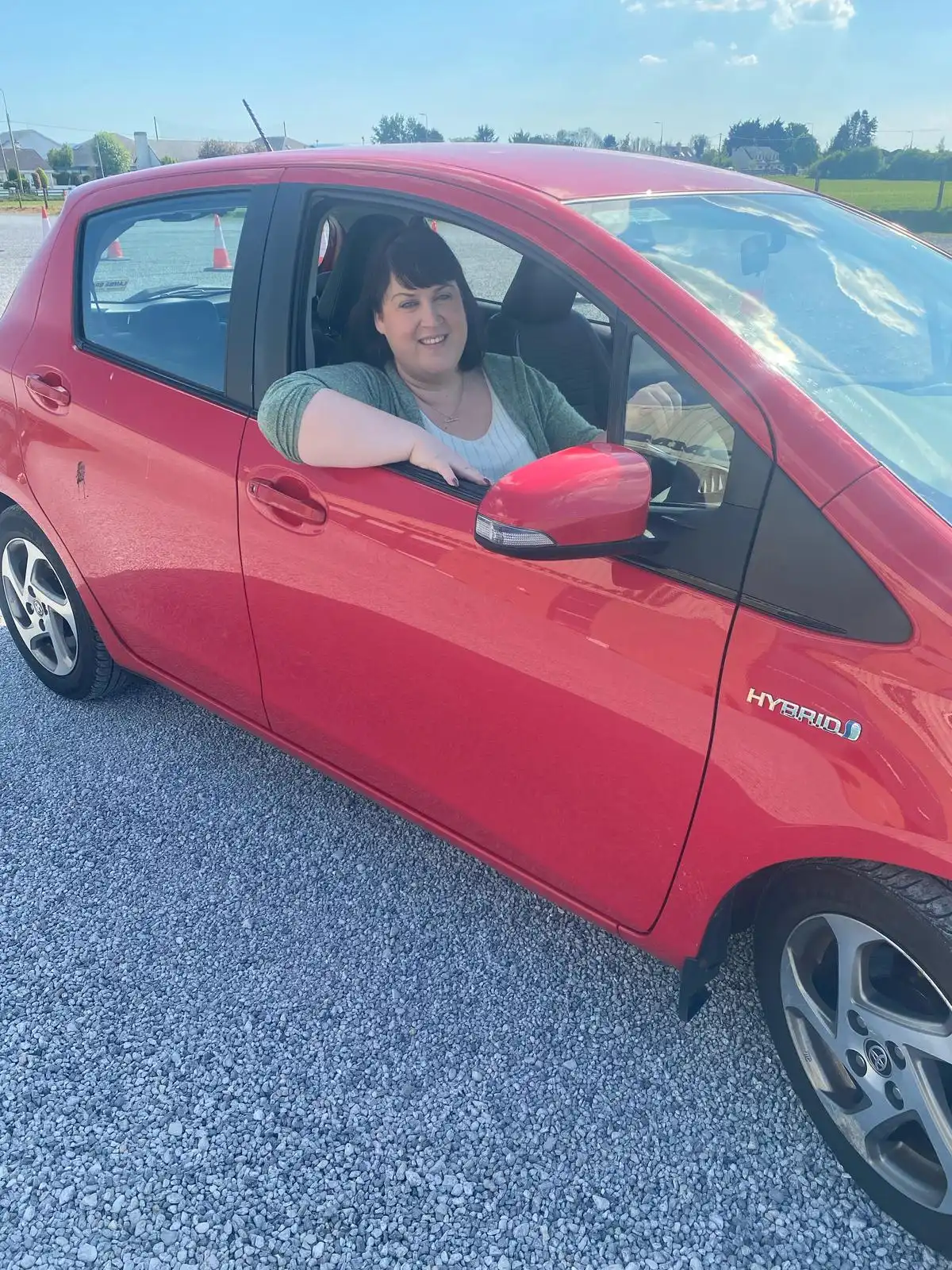
Lorraine Regan sits in the driver's seat of a red car, smiling and leaning out of the window. The background shows a bright, sunny day with green fields and a gravel parking area. Lorraine is dressed in a green cardigan and has short dark hair.
Lorraine Regan, from Kilcormac, County Offaly, smiles confidently as she drives her car, celebrating her newfound freedom after learning to drive.
Page 3

Mobility Life

The Benefits of Assistive Technology in the Home
Digital Assistive Technology (AT) offers a powerful range of solutions to support people to live more independently and participate in daily life: at home, in education, at work and in their communities.

It is well documented that people with disabilities continue to face a range of social, environmental, economic, and attitudinal barriers which hinder social inclusion. Equally, it is recognised that the participation of people with disabilities as citizens, students, customers, and employees, benefits society. The ability of our members to fully participate in all aspects of daily life often depends on the use, availability, maintenance, and affordability of assistive technology.

Irish Wheelchair Association is an Approved Housing Body that provides 51 wheelchair-accessible homes to Dublin, Kilkenny, Carlow, Tipperary, Mayo, Roscommon, and Galway tenants.

We are a leading expert in providing wheelchair-accessible homes and designing accessible environments. Our homes have won many awards for their clever use of accessible design and provision of assistive technology. All our houses have varying degrees of Assistive Technology depending on funding and individual tenant requirements.

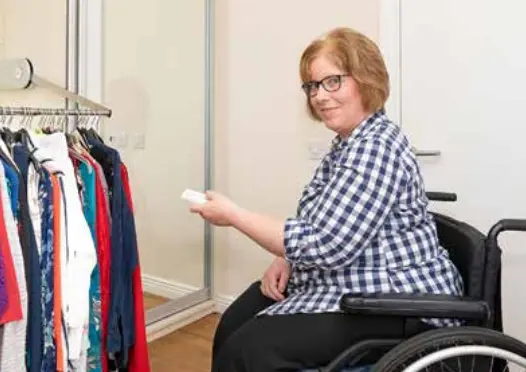
Teresa Gaughan is an IWA tenant living in An Fraoch, Belmullet, and has a range of assistive technology in her home. This technology has made Teresa more independent. She says: “Quite simply put if I didn’t have all the technology that we have in the homes I’d be dependent on people to help me to do simple things like closing the curtains.”

Teresa feels safe and secure in her home with an intercom system, which provides a level of security for our tenants, allowing them to speak to and allow access to visitors. Automated external and internal doors give freedom of movement with minimal effort within the home. Height-adjustable kitchen worktops allow wheelchair users to prepare and cook their meals easily and safely, facilitating both wheelchair users and other users.  Automatic lights also give our tenants control of the levels and amount of lighting in the home. They can be operated from anywhere in the house, e.g., via an app on their mobile phone or other devices.

eresa Gaughan, a woman in a wheelchair, sits in front of a wardrobe, using a remote control to adjust the clothing racks. She is wearing a blue and white checkered shirt and glasses. The wardrobe is filled with clothes.
Teresa Gaughan, an IWA tenant in An Fraoch, Belmullet, demonstrates how accessible living spaces, like her remote-controlled wardrobe, empower individuals with disabilities to live independently.

“Life is so much easier now because of assistive technology,” said Teresa.

Automated wardrobe rails means being able to bring their clothes down to their level, choose their clothes, and put away their clothes.  “It’s an absolute game-changer,” enthused Teresa.  “You press a button, your clothes come down and you just pick out your clothes, and you press the button and the clothes go back up.  It’s just brilliant.” Automatic curtains and blinds allow the tenant to open and close the curtains and blinds at the click of a button.

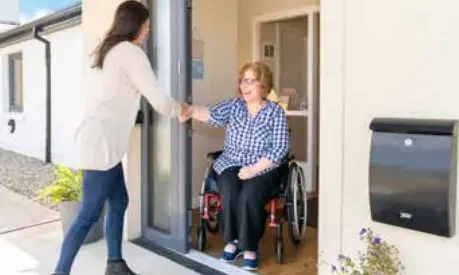
Teresa Gaughan, a woman in a wheelchair, shakes hands with a visitor at her accessible home. The entrance features a modern design with a flower bed and mailbox, showcasing an accessible and welcoming environment.
Teresa Gaughan greets a friend at her home in Belmullet

Rosaleen Lally,  IWA’s National Access Programme Manager, can support and advise members who may be thinking about assistive technology. “While technology can be retrofitted into a home, it is preferable to forward-plan for the use of technology and to install any wiring or electrical connections when a new house or retrofit is being planned and designed,” she said.

“Environmental controls can enable a person to live more independently and safely by using technology to manage and control activities and equipment within the home environment. Technology can be wired into living spaces and used to control and manage such activities as: opening and closing doors/windows/ curtains; turning on and controlling TV, radio, music systems and heating and providing intercom connections between bedrooms and living areas.”

Rosaleen adds that when considering any present and future technology or equipment requirements, the possible future need for a hoist should also be considered, and an electrical connection at ceiling height should be provided in an appropriate location. It is worth noting that fixed-track hoists can now be funded within the scope of the Housing Adaptation Grants for Older People and People with Disabilities Schemes.

Grants of up to €30,000 are available to assist people with disabilities in carrying out necessary works to make a house more suitable for their needs. Additionally, grants of up to €6,000 are available for mobility aids. These schemes can now be used to cover the cost of installing a fixed-track hoist.

For more information on funding for tracking hoists, contact IWA National Housing Programme Manager Jean Coleman.

Rosaleen is available to advise and support anyone considering installing assistive technology.

Assistive Technology makes a difference

Video Thumbnail

More information

image showing IWA Housing Manager Jean Coleman beside a graphic of IWA's Think Ahead, Think Housing logo

Housing

Always available to support our members with any housing issues that they may have. Jean offers a wealth of information and guidance on housing grants, social housing applications and government housing support schemes.

Contact Jean

Tel: 085 875 1243

Email: jean.coleman@iwa.ie

image showing IWA National Access Programme Manager Rosaleen Lally beside a graphic of IWA's Best Practice Access Guidelines cover

Access

Dedicated to providing support to members who may face any accessibility challenges in their community. Whatever your access query is Rosaleen is on hand to offer assistance and guidance.

Contact Rosaleen

Tel: 087 212 8215

Email: rosaleen.lally@iwa.ie

Page 6

Adaptive Fashion: Style Meets Function

Empowering Self-Expression for Every Body
Fashion is more than clothing—it's self-expression and empowerment. For many with disabilities, mainstream fashion often lacks accessibility and functionality.

Adaptive fashion solves this, offering stylish clothing that meets diverse needs. Whether using wheelchairs, prosthetics, or medical devices, adaptive fashion ensures confidence, comfort, and individuality.

In this issue of SpokeOut, we explore the evolving world of adaptive fashion. We highlight innovative brands and designs that prove fashion has no limits. With a variety of price points and delivery to Ireland, these brands make adaptive wear accessible to all at the Irish Wheelchair Association.

Featured Adaptive Fashion Brands: Where Style Meets Function

Today’s adaptive fashion blends style, comfort, and function. These brands are reshaping the landscape, offering tailored, stylish designs for those with mobility and medical needs. From essentials to high-quality designs, these brands ensure everyone can look and feel their best, with delivery to Ireland.

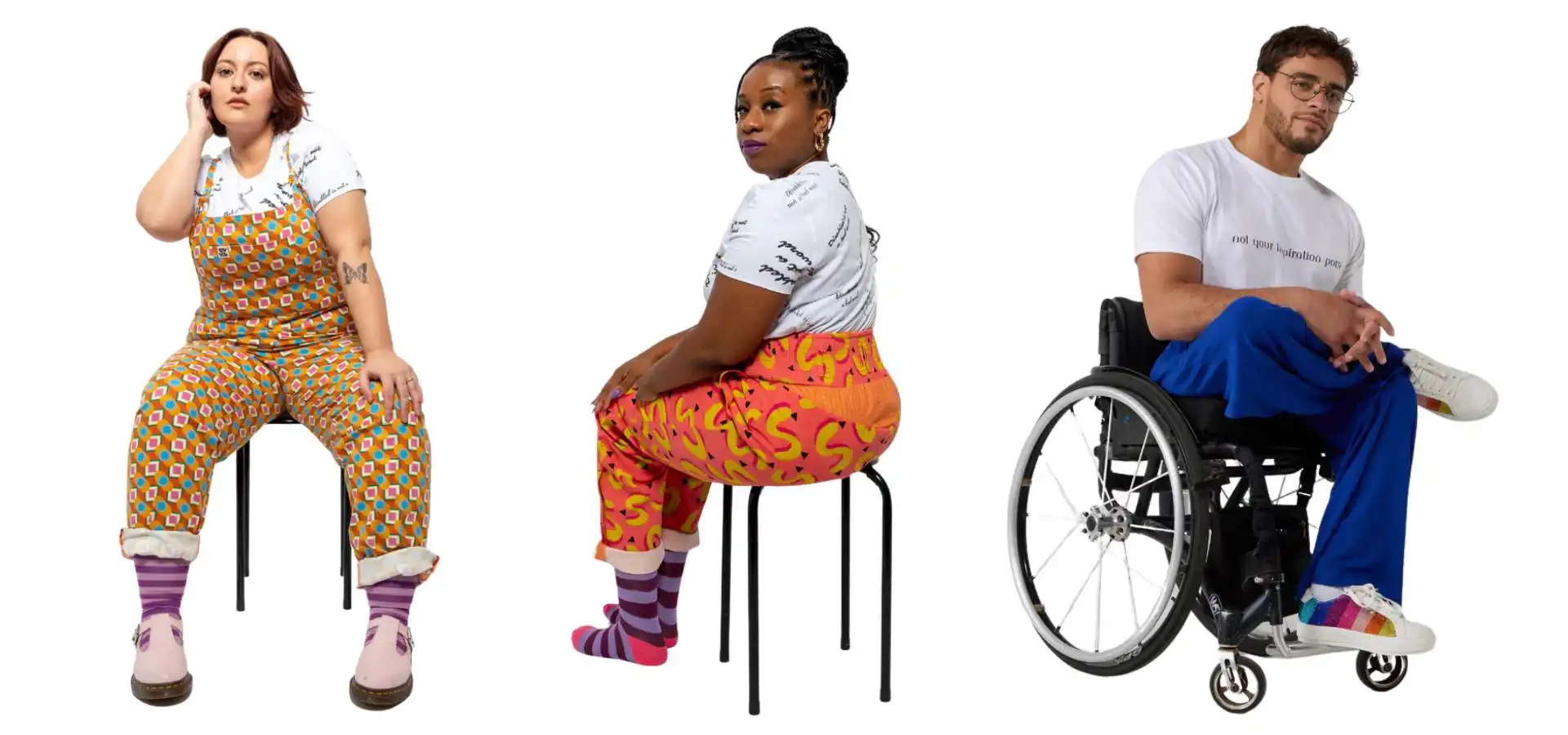
Unhidden Clothing

  • Style: Modern & Trendy
  • Price: €50–€150
  • Key Features: Magnetic closures, adjustable hems, side access

Unhidden Clothing combines modern fashion with adaptive features like hidden Velcro fastenings and adjustable hems, ensuring easy dressing while keeping a stylish look.

Shop Unhidden Clothing

Three models wearing adaptive clothing from Unhidden Clothing: On the left, a woman with short hair wearing colorful patterned overalls and pink shoes sits on a chair. In the middle, a woman in bright patterned pants and socks sits on a chair, smiling. On the right, a man in a wheelchair wears blue pants, a white shirt with "not your inspiration porn" printed on it, and rainbow-colored sneakers, sitting confidently.
Unhidden Clothing combines modern fashion with adaptive features like magnetic closures, adjustable hems, and side access, making it easy to dress without compromising on style.

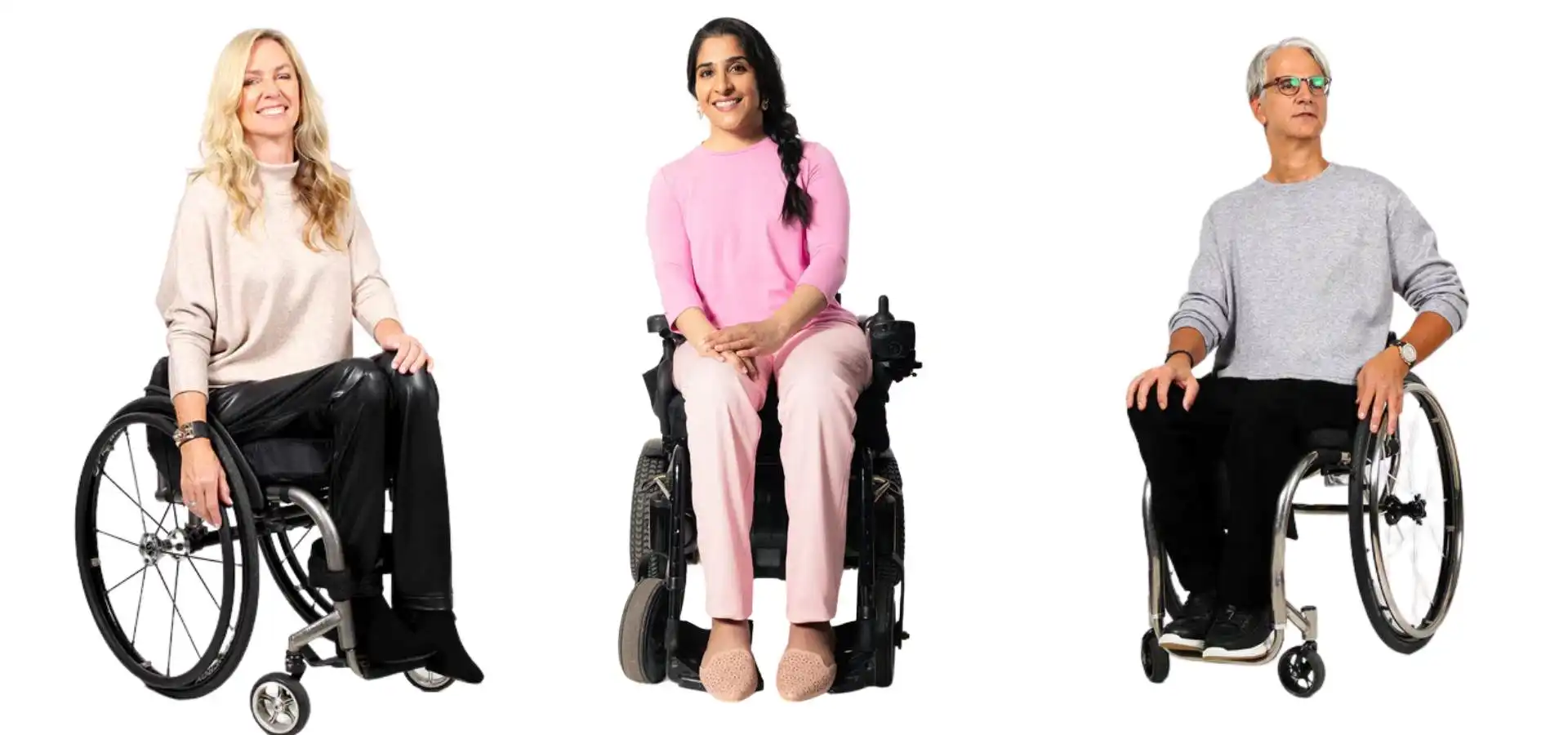
IZ Adaptive

  • Style: Chic & Functional
  • Price: €50–€400
  • Key Features: Seamless technology, seated cuts, magnetic closures

IZ Adaptive offers stylish wheelchair-friendly clothing like Seamless Back Pants, designed for long sitting periods. Their pieces ensure mobility and comfort without sacrificing style.

Shop IZ Adaptive

Three models wearing clothing from IZ Adaptive: On the left, a woman in a beige sweater and black leather pants sits in a wheelchair. In the middle, a woman in a pink top and light pink pants sits in a wheelchair. On the right, a man in a gray sweatshirt and black pants sits in a wheelchair, showcasing the stylish and adaptive clothing from IZ Adaptive.
IZ Adaptive combines chic and functional designs with wheelchair-friendly features, such as seamless technology and seated cuts.

Penneys (Primark) – Adaptive Collection

  • Style: Trendy & Casual
  • Price: €5–€26
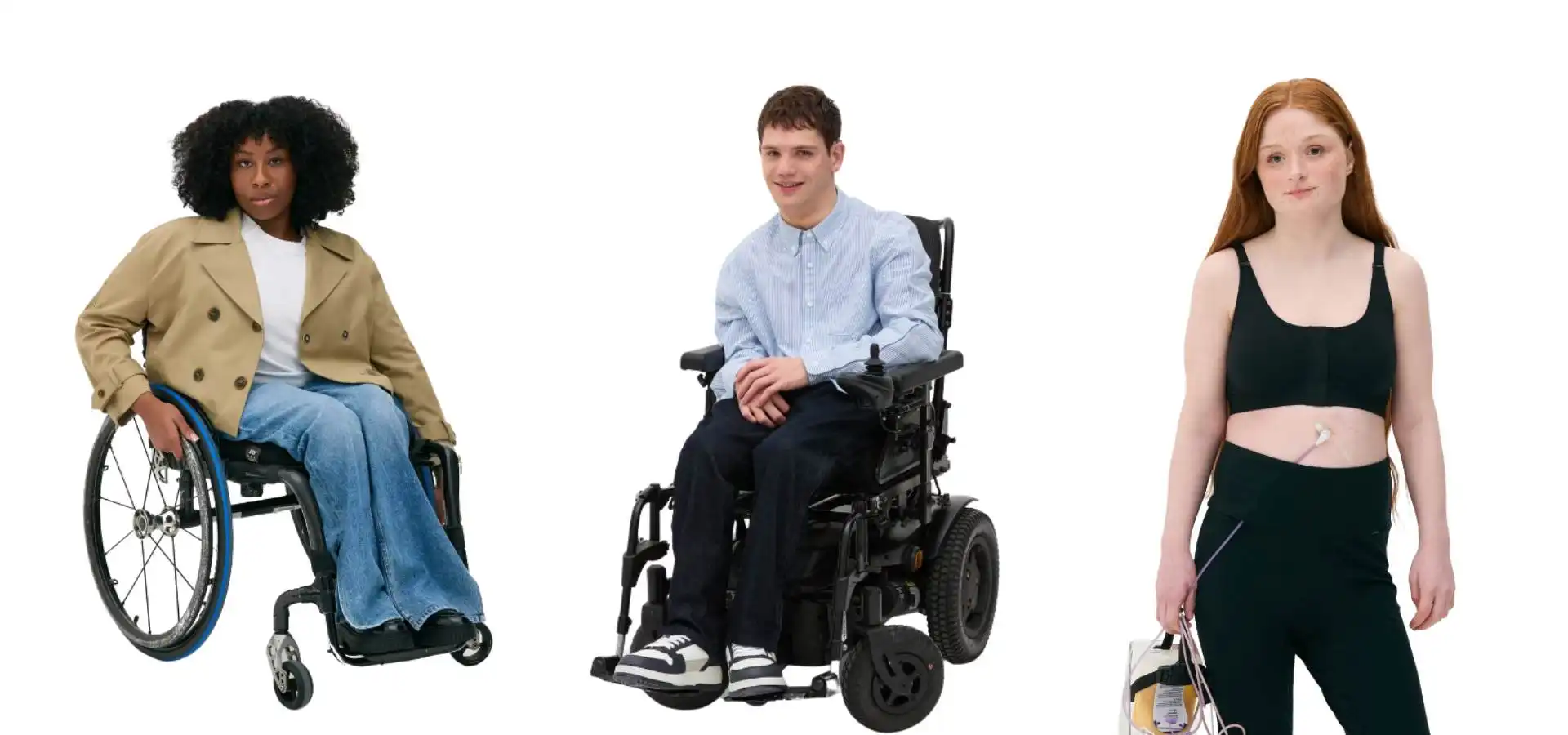
  • Key Features: Magnetic closures, medical device access, seated-friendly designs

Penneys’ 49-piece collection includes stylish essentials like tees, jumpers, and jeans, with adaptive features such as magnetic zips and side openings for medical devices. Affordable and chic, this collection makes adaptive fashion accessible.

Shop the Collection

A promotional image showing three models wearing clothing from Penneys' Adaptive Collection. On the left, a woman in a wheelchair wears a beige jacket and blue jeans. In the middle, a man in a wheelchair wears a blue button-down shirt and dark jeans. On the right, a young woman wearing a black crop top and pants with a medical device attached to her stomach holds a bag. The background is a clean, white backdrop.
The Penneys (Primark) Adaptive Collection brings trendy and casual fashion to individuals with disabilities. With features like magnetic closures, medical device access, and seated-friendly designs.

JAM the Label

  • Style: Casual & Sensory-Friendly
  • Price: €40–€120
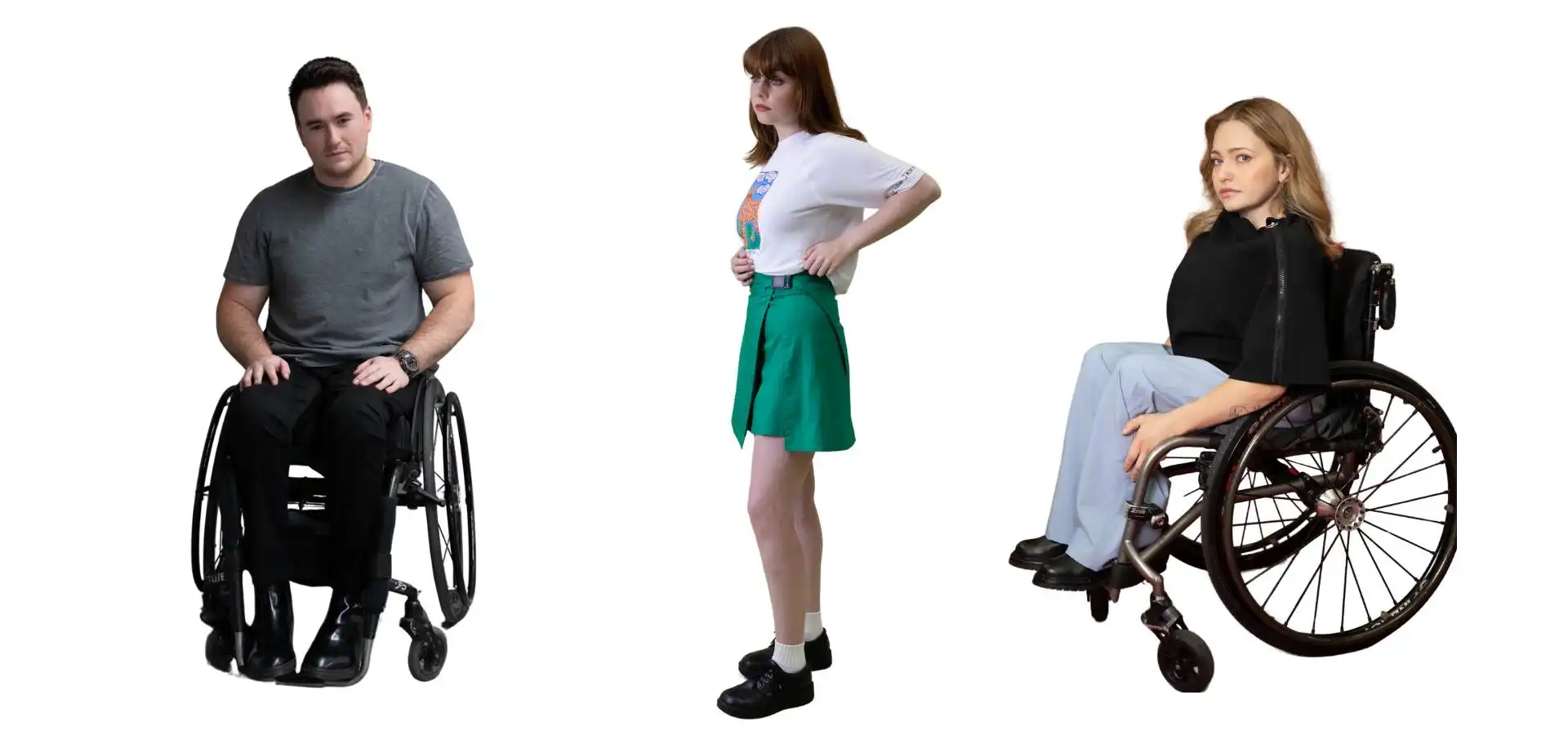
  • Key Features: Magnetic closures, flat seams, tagless labels

JAM the Label’s sensory-friendly clothing, designed by occupational therapists, features magnetic closures and soft fabrics, making it comfortable for everyday wear.

Shop JAM the Label

Three models wearing clothing from JAM the Label: On the left, a man in a gray t-shirt and black pants sits in a wheelchair. In the middle, a woman wears a white t-shirt and green skirt, adjusting her outfit while standing. On the right, a woman in a black top and light blue pants sits in a wheelchair, showcasing the brand’s sensory-friendly and adaptive designs.
JAM the Label offers sensory-friendly clothing designed by occupational therapists. With magnetic closures, flat seams, and tagless labels, this casual and comfortable collection is perfect for everyday

Intotum

  • Style: Minimalist & Functional
  • Price: €40–€200
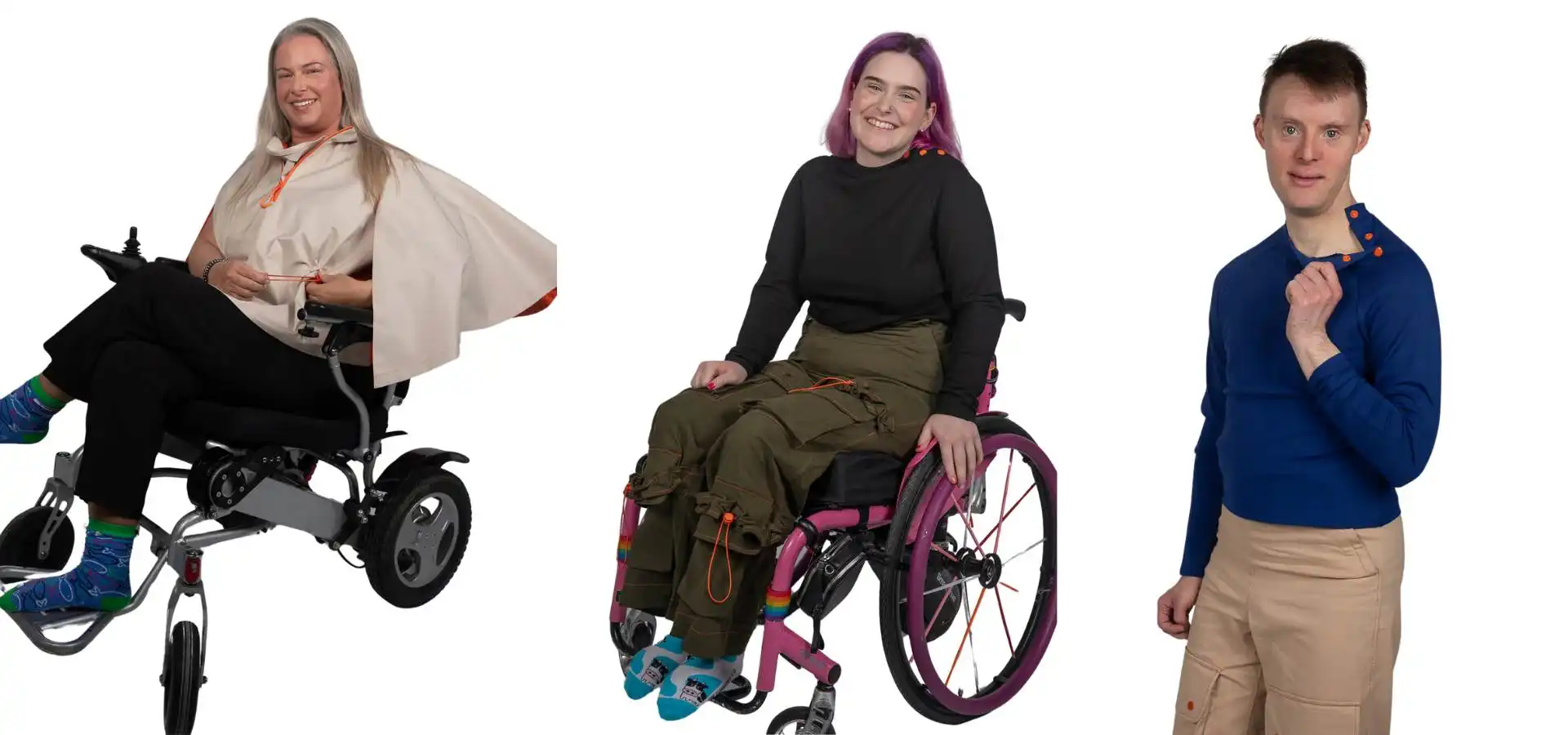
  • Key Features: Magnetic fastenings, adjustable designs

Intotum’s minimalist clothing features easy-to-dress designs with magnetic fastenings and adjustable fits, offering practicality without sacrificing style.

Shop Intotum

Three models wearing minimalist clothing from Intotum: On the left, a woman in a beige cape-style top with rainbow socks sits in a wheelchair. In the middle, a woman in a black top and green cargo pants sits in a wheelchair, showing off colorful socks. On the right, a man wears a blue long-sleeve top and beige pants, with a magnetic fastener on his shirt, demonstrating the brand’s stylish and functional adaptive designs.
Intotum’s minimalist and functional designs blend style with practicality. With magnetic fastenings and adjustable fits, their clothing makes dressing easier while maintaining a chic look

Adaptawear

  • Style: General Adaptive Wear
  • Price: €20–€80
  • Key Features: Magnetic fastenings, elasticated waist trousers

Adaptawear offers functional, stylish clothing, including open-back nightwear and elasticated waist trousers, designed for comfort and ease of dressing.

Shop Adaptawear

Three models wearing clothing from Adaptawear: On the left, a woman wearing a white floral-patterned blouse with a button-down design smiles at the camera. In the middle, a woman in a white short-sleeve top with lace trim stands with her hands at her waist, looking at the camera. On the right, a man in a blue and white checked button-down shirt stands, smiling with his hands in his pockets, showcasing Adaptawear's functional yet stylish designs.
Adaptawear offers practical and stylish adaptive clothing, including open-back nightwear and elasticated waist trousers, all designed for comfort and ease of dressing.

These six brands offer stylish, functional adaptive clothing that prioritises comfort without compromising on style, making fashion accessible to all.

Other Noteworthy Adaptive Fashion Brands Delivering to Ireland

Tommy Hilfiger Adaptive: Classic preppy styles with easy-to-use closures for everyone.

Nike EasyOn: Nike’s EasyOn shoes feature hands-free entry designed to make dressing easier for individuals with limited mobility.

Lucy & Yak (Unhidden x Lucy & Yak Collection): Known for stylish, comfortable, and inclusive designs with adaptive features.

Adaptawear: A great range of adaptive clothing for seniors and individuals with mobility issues.

Liberare: Stylish and functional bras and underwear for individuals with disabilities.

Aille Design: Each garment features tactile Braille messages, allowing wearers to “read” their clothing through touch.

The Able Label: Stylish adaptive clothing with features like Velcro fastenings and hidden extras to make dressing easier.

Vilber’s Adaptive Clothing: Wheelchair-specific clothing with stylish and discreet designs.

Silvert’s Adaptive Clothing: Adaptive fashion that blends comfort, functionality, and style for all.

Joe & Bella: Casual, comfy clothing for wheelchair users.

Sparkies: Fashionable clothing for women with disabilities.

Liberare: Adaptive intimates designed for easy dressing.

Anthropologie Adaptive Collection: Stylish, accessible clothing designed with the disabled community in mind.

AUF AUGENHOEHE: Fashion for individuals with dwarfism, with custom sizing and adaptive features.

DEWEY: Petite and extra-petite clothing designed for style and comfort.

Crazy Compression: Fun-design medical-grade compression socks.

Von Ruz: High-fashion aesthetics with functional design elements, catering to individuals of all abilities.

Bivolino: Specializes in made-to-measure shirts with an emphasis on sustainability.

So Yes Adaptive Clothing: Wheelchair-friendly, medical device-friendly, inclusive apparel.

SIIL Ostomy: Spanish brand specializing in stylish, functional clothing designed specifically for individuals living with an ostomy.

Differently Enabled: Adaptive clothing that is both functional and fashionable, offering customizable options to meet specific needs.

Zalando Adaptive Fashion: A wide range of accessible fashion, including adaptive collections from brands like Tommy Hilfiger.

IE SpecialKids Adaptive Store: Adaptive clothing for children and adults with special needs.

SKIMS Adaptive Collection: Stylish intimates that are accessible and easy to wear.

Kinetic Balance: Wheelchair-specific apparel for seated comfort and style.

Loud Bodies: Inclusive & sustainable fashion – customizable and disability-friendly.

Page 4

IWA launches first-ever Young Adults Skillsfest

Competitions in Art, Boccia, and more
There’s nothing like a little bit of competition and camaraderie! And that’s what IWA’s latest initiative, Skillsfest, is all about.

Our First Young Adults Skillsfest festival is now underway with competitions in a range of categories including Art, Boccia, Photography, Baking as well as a Team Quiz.

It’s hoped that the pilot programme will encourage our young adults to further develop the various skills they learn daily through our Young Adult Service as well as provide an opportunity to bring them together for the team events.

Members at the Galway rounds of Boccia Skillfest 2025
Members at the Galway rounds of Boccia Skillsfest 2025

And it’s already proving a big hit with the roll out of the Boccia and Art Competition last month generating a huge response and in the case of Boccia some very close matches!

Sarah Rothwell, National Development Officer – Young Adults said: “The opening rounds of the Boccia competition have been very exciting and our young people have really enjoyed it.  It’s been fantastic to see them putting the skills they have learned into action in this competition.  We are all looking forward to the finals.”

She said that the idea behind Skillsfest is to showcase the talents of our young adults.  “During the year in their own centres they are constantly learning new skills like art, baking, , photography and so on.  Skillsfest is an opportunity to display what they have learned in a competitive environment, and we are delighted with the response so far.”

“It also enables members from different parts of the country to come together and compete, and in turn get to know one another.”

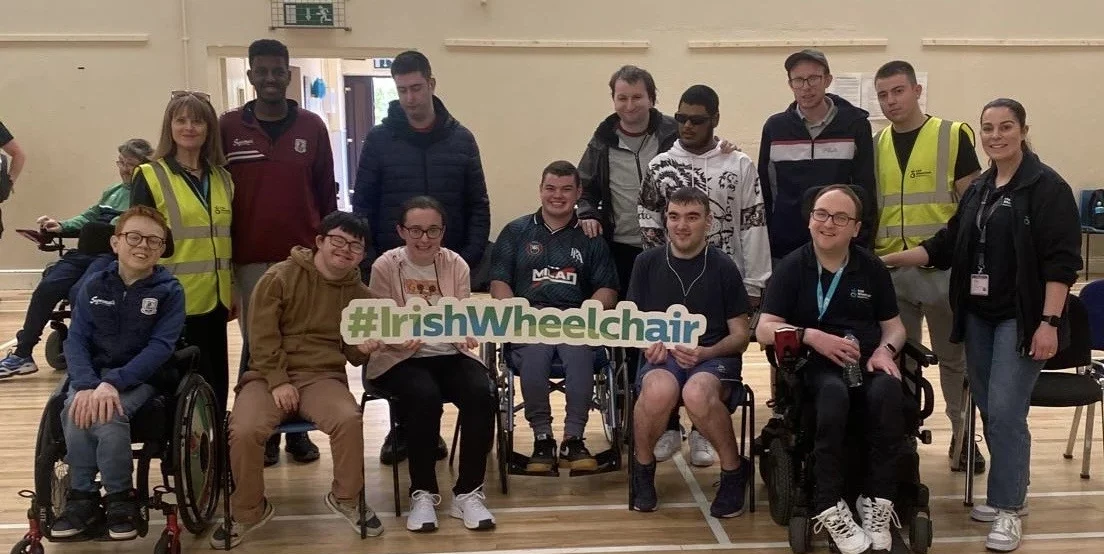
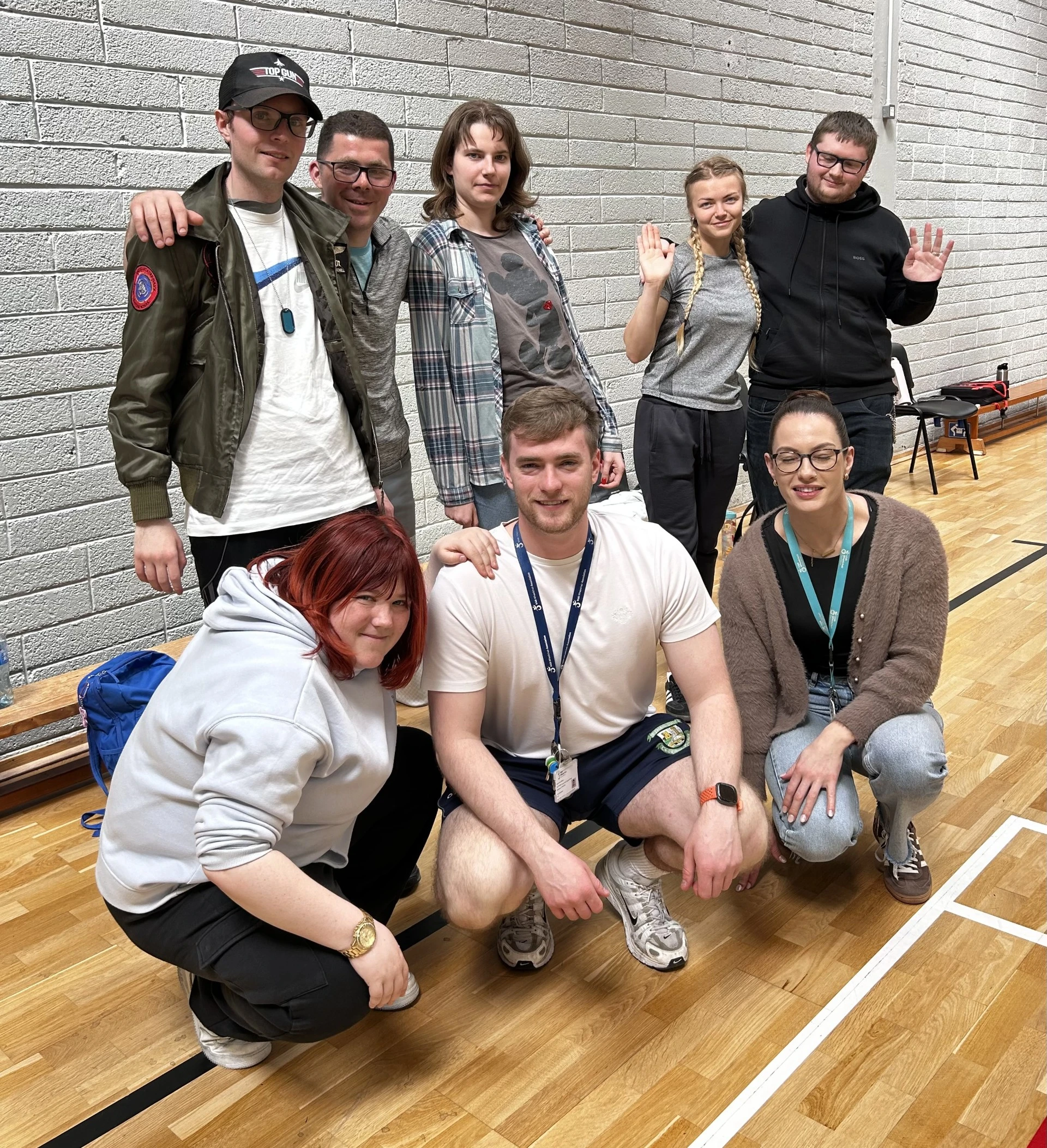
A group of participants are gathered at the Dundalk Boccia rounds of Skillfest 2025. The group includes wheelchair users and other members, all smiling and posing together. They are inside a gymnasium with a plain wall behind them, ready for the competition.
Members at the Dundalk rounds of Boccia Skillsfest 2025

She added: “Myself and Sean Whelan, Project Lead, built the idea from a sports project in Ardee, who ran Boccia competitions, and it was a great opportunity for the members to meet and socialise with each other, while the competition gave them opportunity to learn a new skill and develop teamwork.”

“So, we took that concept and added in different competition in different skills base activities, which we hope will apply to more people and help showcase different people’s abilities.”

So far, she said,  it has been a great success, with loads of uptake from the different services in the Boccia and Art competitions, which are the first two competitions roll out.

“It’s been a really positive experience to be part of and we are looking forward to the various events in the months ahead.”

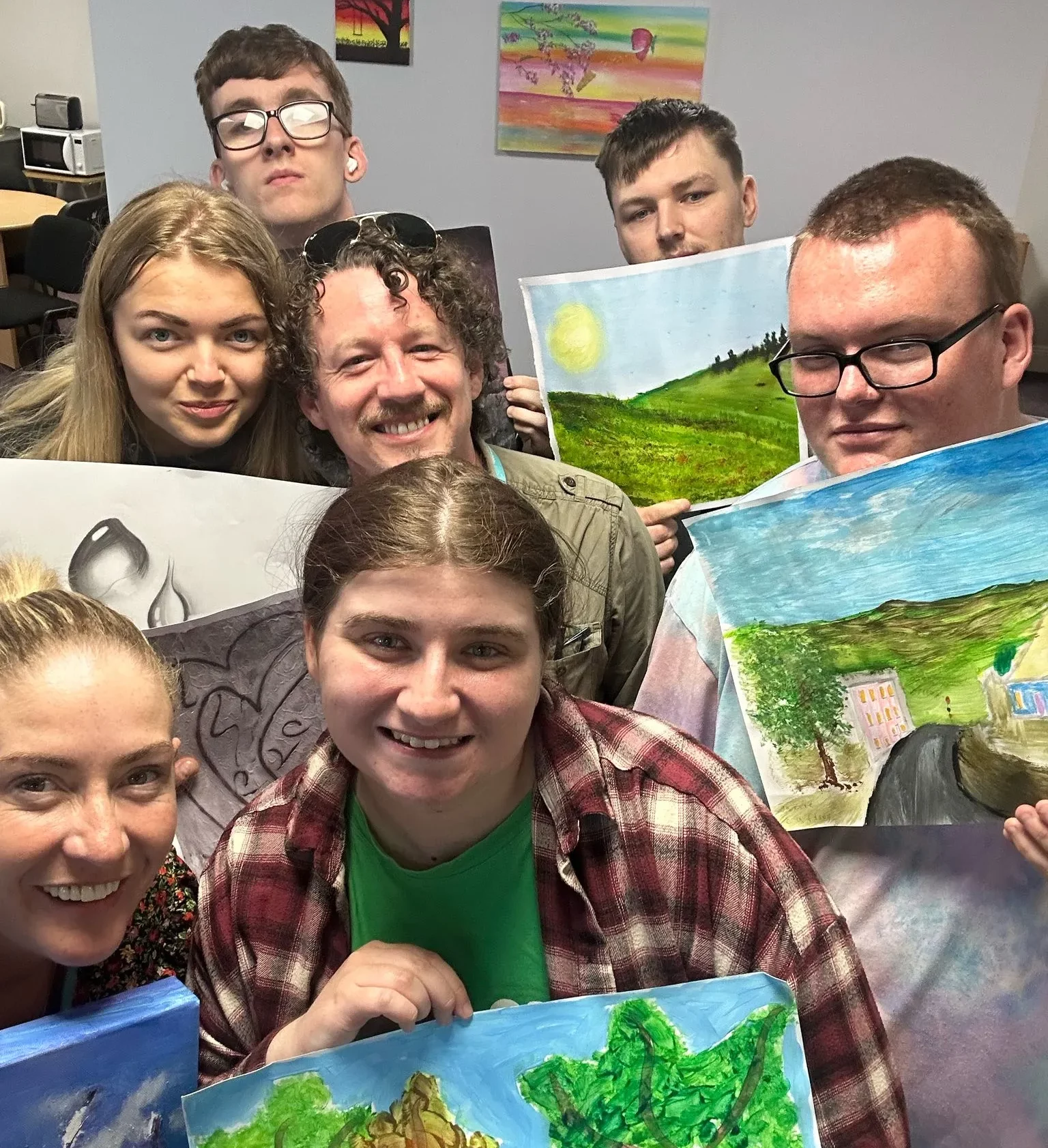
A group of young adults from Drogheda’s Young Adult Service stand together holding their art entries for the Skillfest Art Competition 2025. The group is smiling and posing in front of brightly colored paintings. The setting is an indoor space with a clean, white wall and other artworks visible in the background.
Members of Drogheda's Young Adult Service pictured dropping off their entries for the Skillsfest Art Competition 2025
Page 8

Thanks for your company

If you like what you're reading, please spread the word!

Share Spokeout May 2025


Share this article on Facebook Share this article on Instagram Share this article on LinkedIn Share this article on X

Remember:
Your voice, your choice! We're all ears for your feedback, thoughts, and suggestions.
Share what topics intrigue you the most and what you'd love to see in future magazine features.

Share your feedback here

Spokeout Cover Image Logo
SpokeOut is Irish Wheelchair Association's lifestyle magazine published every month for our members.
© Irish Wheelchair Association 2025.