


Share this Article


It is well documented that people with disabilities continue to face a range of social, environmental, economic, and attitudinal barriers which hinder social inclusion. Equally, it is recognised that the participation of people with disabilities as citizens, students, customers, and employees, benefits society. The ability of our members to fully participate in all aspects of daily life often depends on the use, availability, maintenance, and affordability of assistive technology.
Irish Wheelchair Association is an Approved Housing Body that provides 51 wheelchair-accessible homes to Dublin, Kilkenny, Carlow, Tipperary, Mayo, Roscommon, and Galway tenants.
We are a leading expert in providing wheelchair-accessible homes and designing accessible environments. Our homes have won many awards for their clever use of accessible design and provision of assistive technology. All our houses have varying degrees of Assistive Technology depending on funding and individual tenant requirements.
Teresa Gaughan is an IWA tenant living in An Fraoch, Belmullet, and has a range of assistive technology in her home. This technology has made Teresa more independent. She says: “Quite simply put if I didn’t have all the technology that we have in the homes I’d be dependent on people to help me to do simple things like closing the curtains.”
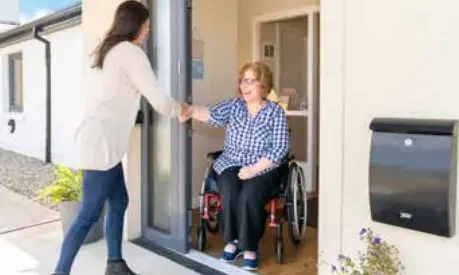
Teresa feels safe and secure in her home with an intercom system, which provides a level of security for our tenants, allowing them to speak to and allow access to visitors. Automated external and internal doors give freedom of movement with minimal effort within the home. Height-adjustable kitchen worktops allow wheelchair users to prepare and cook their meals easily and safely, facilitating both wheelchair users and other users. Automatic lights also give our tenants control of the levels and amount of lighting in the home. They can be operated from anywhere in the house, e.g., via an app on their mobile phone or other devices.
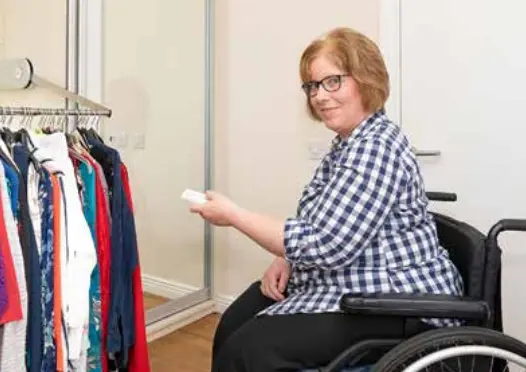
“Life is so much easier now because of assistive technology,” said Teresa.
Automated wardrobe rails means being able to bring their clothes down to their level, choose their clothes, and put away their clothes. “It’s an absolute game-changer,” enthused Teresa. “You press a button, your clothes come down and you just pick out your clothes, and you press the button and the clothes go back up. It’s just brilliant.” Automatic curtains and blinds allow the tenant to open and close the curtains and blinds at the click of a button.
Rosaleen Lally, IWA’s National Access Programme Manager, can support and advise members who may be thinking about assistive technology. “While technology can be retrofitted into a home, it is preferable to forward-plan for the use of technology and to install any wiring or electrical connections when a new house or retrofit is being planned and designed,” she said.
“Environmental controls can enable a person to live more independently and safely by using technology to manage and control activities and equipment within the home environment. Technology can be wired into living spaces and used to control and manage such activities as: opening and closing doors/windows/ curtains; turning on and controlling TV, radio, music systems and heating and providing intercom connections between bedrooms and living areas.”
Rosaleen adds that when considering any present and future technology or equipment requirements, the possible future need for a hoist should also be considered, and an electrical connection at ceiling height should be provided in an appropriate location. It is worth noting that fixed-track hoists can now be funded within the scope of the Housing Adaptation Grants for Older People and People with Disabilities Schemes.
Grants of up to €30,000 are available to assist people with disabilities in carrying out necessary works to make a house more suitable for their needs. Additionally, grants of up to €6,000 are available for mobility aids. These schemes can now be used to cover the cost of installing a fixed-track hoist.
For more information on funding for tracking hoists, contact IWA National Housing Programme Manager Jean Coleman.
Rosaleen is available to advise and support anyone considering installing assistive technology.
Assistive Technology makes a difference
More information
Housing
Always available to support our members with any housing issues that they may have. Jean offers a wealth of information and guidance on housing grants, social housing applications and government housing support schemes.
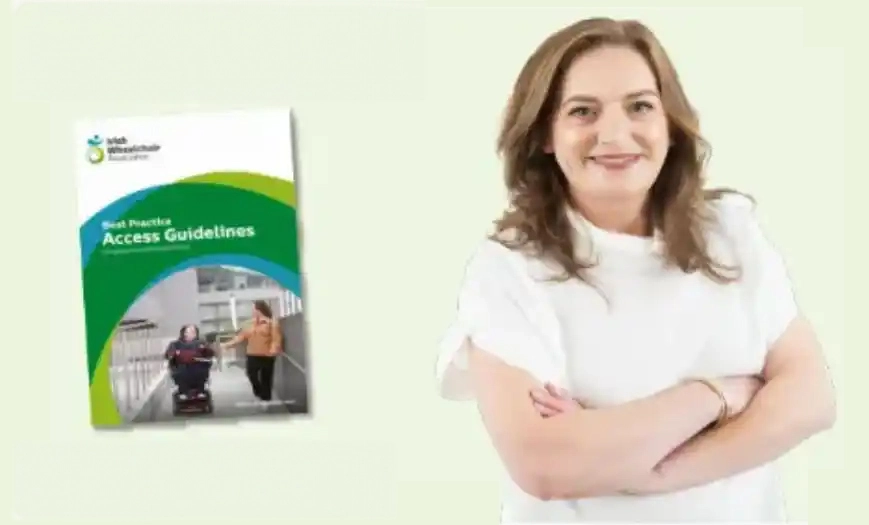
Access
Dedicated to providing support to members who may face any accessibility challenges in their community. Whatever your access query is Rosaleen is on hand to offer assistance and guidance.