


Sport
Share this Article


Twenty years ago, I broke my back. The injury damaged my spinal cord and left me with a life-changing disability. Living with an incomplete spinal cord injury is challenging and while I’ve never shied away from talking about it one-to-one, I haven’t often spoken about it publicly. I’m doing so now because I have more time to help others and because I want more people to know about adaptive sports, particularly my own passion, adaptive skiing.
Since my accident, I can’t walk without assistance and I manage significant balance issues. I’m lucky: with a stick, I can cover a slow kilometre. After several months in the National Rehabilitation Hospital, I left on crutches and yoga has helped enormously since.
Accepting change is hard for most of us. It’s more manageable when there’s hope. In my case, I threw myself into work, we had our own business, so it gave me somewhere to put my energy. That’s a story for another day. Whilst work helped mask the daily difficulties, it left a real gap: what do you do for a family holiday when the things you used to do together no longer work?
Finding equal footing on the mountain
For me, skiing is magical. It’s one of the only times I get to be with my family on close to equal terms. We sit on the chairlift together, we go down the mountain together, we laugh and enjoy the day the way any family does.
My first attempt, seventeen years ago, was a family disaster. Thankfully my wife had had enough and booked adaptive ski lessons in Leeds, UK. I can still picture arriving into a Leeds industrial estate in full ski gear for a weekend on an indoor slope, learning from scratch in a monoski — a single ski with a moulded seat and frame, steered with your body and a pair of outriggers. Everything you knew about skiing on two legs counts for nothing. The UK has excellent facilities for this and organisations like the Back Up Trust do great work getting people started.
In 2025, I got my first chance to ski outdoors in Austria with a community of adaptive skiers and that changed everything — it went from something I could do to something I do. I’m fortunate that I can walk with aids, but on a mountain that doesn’t get you very far. The monoski does.
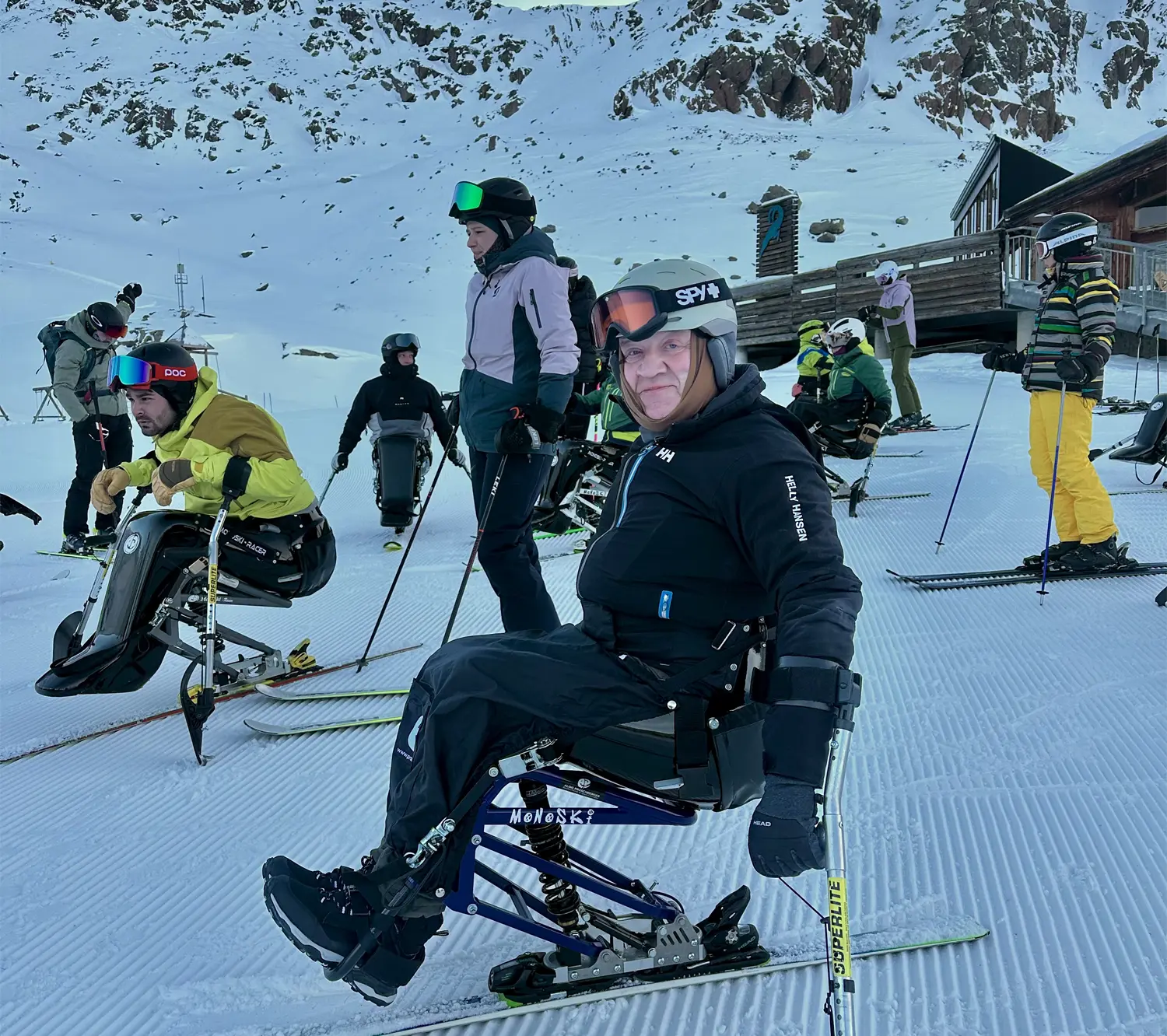
What we're trying to do next: Kaunertal, Austria, 2027
Building on that, there is an opportunity to bring four more people to Austria to learn to ski with the adaptive skiing community there. This isn’t about producing athletes, it’s about handing someone back a week of their life they thought was gone.
A few details on what that looks like in practice:
- The group: part of a wider gathering of 28 adaptive skiers, split into four ability-based groups, with roughly a third skiing for the first time.
- Equipment and manufacturer: Praschberger, the adaptive ski and bike manufacturer, has confirmed they can accommodate a small Irish cohort of 3–5 people for the 2027 trip.
- Instruction: ability-based groups led by highly experienced instructors, several of them former Paralympians.
- Accommodation: Hotel Weisseespitze, which sets a genuinely high benchmark for accessible accommodation — fully accessible rooms, pool hoist access, and saunas usable by everyone.
- Cost: This experience will cost approximately €4,500 per skier, which also accounts for a partner or friend to accompany them. The fee will include a hotel package, renting of a monoski, flights, glacier transfers and cold-weather clothing
Why this matters beyond the mountain
An initiative like this fits squarely into that mission: it builds confidence, creates peer connection for first-time adaptive skiers within a supported, ability-based structure, and — if we tell the story well — raises awareness of what’s genuinely possible, helping to reduce stigma.
That’s really the heart of it. Adaptive sports offer hope, connection and no small amount of fun to people dealing with life-changing injury or disability, the same adrenaline and shared family experience that able-bodied people get to take for granted.
If you want to learn more about adaptive skiing or to learn more about the Kaunertal ski trip, contact Seamus on 086 8051142 or email seamus@seamusreilly.com.
Everything is possible.
Words: Seamus Reilly