


Share this Article


Getting started on tour
I started travelling regularly in 2013, competing as a wheelchair tennis player on the Uniqlo ITF Wheelchair Tennis World Tour. At first, it was just trips across the UK—me, my manual day chair, my tennis chair, my luggage and, of course, my rackets.
Back then, I took the ferry to Holyhead and drove across, which gave me loads of freedom to stay where I wanted and not be tied to the tournament hotel. But once I started hitting tournaments in Europe, flying became the only real option.

In the early days, I had no idea what I was doing. I once chucked my tennis chair—completely unprotected—into the oversized luggage area and just hoped for the best. It came out with a few scratches but no major damage, which was probably pure luck.
I could even carry my rackets in my backpack on board back then—not anymore.
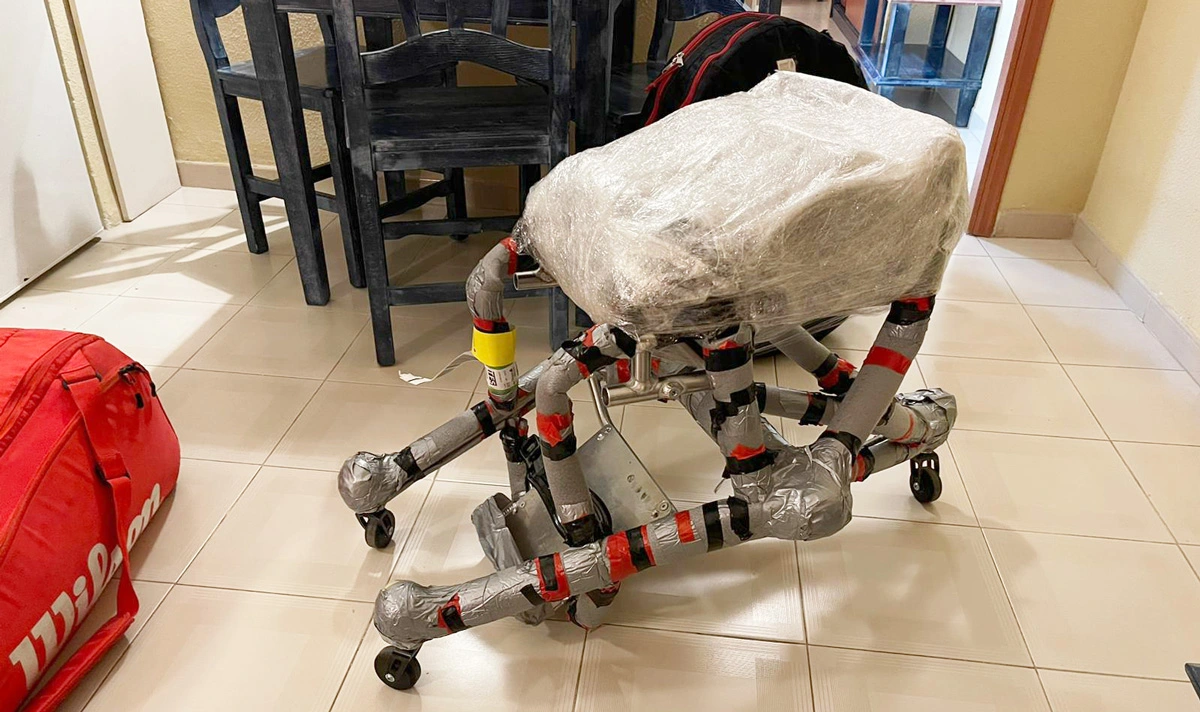
These days, I’m way more prepared. Years of trial and error (and a few mistakes) have taught me how to travel smarter.
Now, I pad the frame of my tennis chair, wrap cling film over the seat to keep it dry and clean, and pack the wheels in a padded wheel bag. Even though that’s technically two items, it still counts as one piece of mobility equipment—which you’re legally allowed to bring along, free of charge, alongside your personal chair.
The not-so-simple side of flying
Regular travellers deal with delays, lost luggage, ticket issues—you name it. But when you add a wheelchair, and maybe assistance, you’re suddenly juggling way more things that can go wrong.
Still, I’ve found that staying calm, being respectful, and treating people decently—even when things go south—gets better results. Nine times out of ten, the person you’re talking to isn’t the one who caused the issue. It’s usually some system or policy in the background that hasn’t caught up with reality.
Biggest frustration? Your chair not being delivered to the plane door
This is probably the most infuriating thing: arriving at your destination only to be told your day chair has been sent to baggage claim instead of being delivered to the aircraft door. Suddenly, you’re stuck using an airport wheelchair, or worse a recliner chair you cant control—something that instantly robs you of your independence.
It’s not usually the assistance team’s fault. It’s down to poor tagging or outdated baggage handling rules. Still, it never gets less annoying. Deep Breaths.
Things have improved (Mostly)
Compared to when I first started flying, things have definitely gotten better. Fewer issues with missing or damaged chairs. Staff are more aware. And most airlines I’ve travelled with have generally been good.
But that doesn’t mean the system is perfect. Thousands of mobility aids are damaged or lost by airlines every year—and everyone seems to have a horror story.
Airline Differences
Some airlines have made me board last and sit at the back (not mentioning any names… Ryanair), which can feel humiliating when you’re wheeled through a packed plane. Other airlines let me board first and sit up front, which is a much smoother experience. Legally, wheelchair users must sit in a window seat—fine by me, as middle or aisle seats are a nightmare.
I’ve also started seeing aisle chairs on short-haul flights, which is new—and brilliant. Being able to use the toilet on board makes a big difference. On long-haul flights, I always ask at check-in if there are any empty rows. If they’re available, they usually let me lie down—once I explain why.
Tips for flying as a wheelchair user
Booking flights and assistance
- Always book assistance in advance—during or immediately after flight booking. Unfortunately, you may have to dig through the airline website to find the right page. If you book through a deal website like skyscanner, then you’ll have to contact the deal website or the source airline if the deal website doesn’t capture the assistance info.
- If you’re bringing mobility equipment, including a sports wheelchair, do not select sports equipment in your website booking or you will be charged extra. Sports equipment is extra but Mobility equipment is free and can be declared at check-in desk unless you travel with battery powered equipment.
- If flying from Dublin Airport, you can book Blue Badge parking online for a discounted rate near the terminal. You need to apply for a discount code (PRM code) first and then book your airport parking using the PRM code. You must have a valid Disabled Persons Parking Permit to do this.
Packing and preparation
- Pack your extra mobility equipment the day before with padding and wrap the seat or electronics with cling film (remember to bring cling film with you for the return trip!).
- Use a padded wheel bag for any removable wheels or additional mobility gear.
- Carry a few days medical supplies and essentials in your carry-on in case your main luggage is lost.
At the airport
- Go to the assistance desk first. They’ll confirm your assistance (very important!), help you manage check-in, tagging, oversized baggage and give you as much assistance as you need. They’ll also bring you to the front of the check-in and security queues.
- Ask the check-in desk or assistance what gate your flight is, they generally know ahead of the screens what the gate will be.
- You can choose to make your own way through security and to the gate or assistance can help. You can decide this at the assistance desk.
- On your return flight, other airports assistance may differ slightly. Some assistance prefer to bring you to one area after check-in and collect you to travel to your gate. You are still free to shop or get food but you come back to the assistance area at the time agreed.
Boarding the flight
- Assistance may take you via an airbridge or ambi-lift (bus with lift) depending on the airport. Sometimes you may have to be carried up boarding steps but I haven’t seen this in a long time.
- If you need it, an aisle-wheelchair will be provided to transport you to your seat.
- Travel light with your carry-on. Only bring what you need during the flight as extra stuff adds weight or bags you can lose.
- If problems come up, speak calmly and respectfully to staff. It usually leads to a better outcome.
Travel tales: The things you can’t plan for
No matter how well you plan, travel throws you curveballs—especially when you rely on equipment, assistance, or connections. Here are a few of the more memorable experiences I’ve had on the road.
One time I arrived pretty late on a stormy night in Hungary. I seemed to be the only person left in the airport waiting to be picked up by my transfer. It was eerie and honestly a bit scary. The driver eventually showed up around 2 a.m, didn’t speak a word of English, and we had another three-hour drive in lashing rain.
Another time, I couldn’t get my connecting flight to Croatia from the UK because the runway had melted in a heatwave. That was a new one.
The worst transfer I’ve had was in Rome at 6 a.m. I had an eight-hour wait for a connecting flight to Sardinia. I ended up tying my luggage trolley to my chair while sitting in a café, just in case I dozed off and someone tried to steal it. I did fall asleep but thankfully nothing was taken.
The worst flight I had was travelling home from Dubai straight into Storm Desmond with Emirates and that was the roughest turbulence I’ve experienced. After a failed landing attempt (go-around) we tried it again and thankfully we landed safely with lots of white-knuckles and prayers!

Final thought
Travelling as a wheelchair user will never be fully stress-free—but it’s worth it. I’ve seen the world, met amazing people I now call friends, and competed in the sport I love.
The more we travel, the more visible we are—and the more pressure there is to make things better. So, if you’re thinking of going abroad, do it. Just bring your sense of humour and maybe some extra duct tape.
Further information: Battery-powered mobility equipment and air travel
If you’re travelling with a battery-operated wheelchair or mobility device, here are some key legal and practical points:
- You are legally entitled to carry two pieces of mobility equipment free of charge under EU Regulation (EC) No 1107/2006.
- Notify your airline at least 48 hours before your flight if you’re bringing powered equipment.
- Battery type matters. Sealed lead-acid and lithium-ion batteries are typically allowed, but lithium-ion batteries must usually be removable and under 300Wh.
- Battery terminals should be protected from short-circuiting. Some airlines require batteries to be removed and carried in the cabin.
- Carry documentation that confirms the battery type and its compliance with IATA safety standards.
Useful references:
Disclaimer
While I’ve tried my best to get everything as accurate as possible, the above information may be out of date at time of reading. Additionally, I have only my own experience to rely and and do not claim to have solutions for other wheelchair users with different chairs and needs. Hopefully, you will find the info above useful.